01 / CONTEXT & CONSEQUENCEBefore the event
In the Edo period, markets, education, and local administrative networks had already formed, but the shogunate and the domains differed markedly in fiscal, military, and reform capacity. Coastal defense costs, famines, and debt put pressure on rule, and the court's political role again drew attention. The expansion of Western powers in East Asia made the existing diplomatic rules hard to maintain, but Japanese society was not completely isolated from overseas before 1853.
Authority was unevenly distributed among the shogun, the daimyo, and the court, and the military strength and fiscal resources of the domains rose and fell differently, creating conditions for alliances to seize power. The commodity economy and educational networks added new actors and demands, but the old system could not respond to them in a unified way. The international treaty system and imperial competition forced policy to accelerate; external pressure and internal organizational change worked together, and no single one of them can explain it alone.
02 / CONTEXT & CONSEQUENCEHow change unfolded
In 1853 Perry's fleet arrived and demanded relations backed by military force; the 1854 arrangements for supplies and friendly relations and the 1858 commercial treaty further changed the external system. How the shogunate consulted the domains and whether it obtained the court's consent became a domestic legitimacy dispute. The arrival was only a trigger; the specific choices in handling the treaties and the succession of power turned existing difficulties into a deeper political crisis.
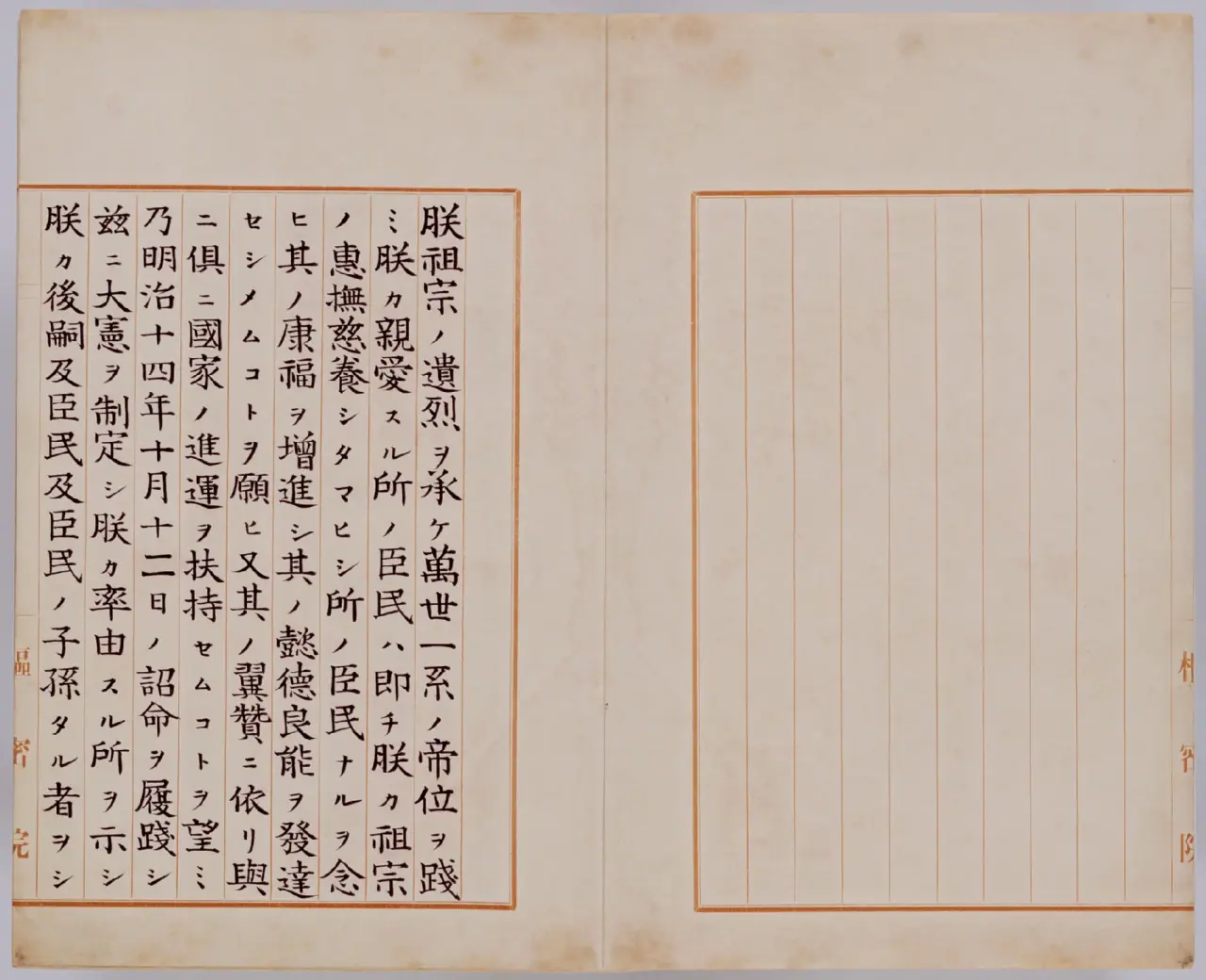
After the restoration of imperial rule in 1867, the attribution of power remained unresolved, and the 1868 restoration of imperial government and the Boshin War advanced the establishment of the new government. In 1871 the abolition of domains and establishment of prefectures, followed by conscription and land tax reform, expanded central mobilization, and schools and industrial projects entered households and localities. The freedom and people's rights petitions and the government's constitutional plans continued to negotiate, and the promulgation of the constitution in 1889 and the opening of the Diet in 1890 formed a new framework of limited participation.
03 / CONTEXT & CONSEQUENCEPeople, institutions and alternatives
The leaders of the overthrow of the shogunate and the Restoration decided alliances, war, and institutional direction, while local samurai, officials, and technicians carried out implementation; freedom and people's rights organizations proposed different constitutional plans, while peasants and factory women influenced reform through labor, migration, petitions, and resistance. Ryukyu also negotiated and opposed annexation; it was not a passive patch of color on a map. Actors had unequal opportunities, and not all social change can be attributed to a few leaders.
Reform within the shogunate, councils of the lords, and different parliamentary plans all entered discussion at the time, and the popular constitutional ideas after the 1870s also show that the system was not a single path. But proposing a plan is not the same as having the military force, finances, or political coalition to carry it out. Assessing alternative paths should rest on the resources available at the time and the interests of participants, neither treating the actual outcome as inevitable nor romanticizing unrealized proposals.
04 / CONTEXT & CONSEQUENCEAfter the turning point
Central administrative, military service, taxation, and infrastructure capacity clearly increased, the old samurai status and domain power were reorganized, and some women and young people gained new educational opportunities. Farming households bore the costs of monetary taxes, conscription, and schooling, and factory labor also carried different burdens. The land, autonomy, and cultural space of residents of Hokkaido and Ryukyu were affected by state expansion, and so-called unification cannot be measured only by gains to the center.
Constitutions, cabinets, parliaments, schools, and industrial organizations became important foundations of modern Japan, and demands for civil rights left behind political resources for later periods. Imperial sovereignty, legal reservations, and limited suffrage in turn restricted equal participation, and state capacity could be used for development as well as for colonization and military mobilization. The Restoration was not the single cause of all later achievements or atrocities, and it remains necessary to continue tracing how institutions were actually used by different groups.
How the event unfolded
The arrival of the fleet and the dispute over decision-making authority
Facing American military deterrence, the shogunate found that foreign relations quickly became a question of domestic authority.
Commercial treaties and political repression
Commercial arrangements made without imperial court approval and the dispute over the shogunal succession provoked opposition, and the Ansei Purge suppressed dissent.
Restoration of imperial rule
Tokugawa Yoshinobu proposed returning governing power to the imperial court, but the conflict over leadership of the new system was not yet over.
The new government and the Boshin War
The restoration of imperial rule and military conflict together changed power, and the civil war cannot be deleted from the story of institutional reform.
Abolition of the domains and establishment of prefectures
The center reorganized local administration, and the former lords and their retainers were gradually replaced by new bureaucratic arrangements.
Taxes, conscription, and households
Land tax and conscription reforms brought state demands more directly into farming households, and reactions to reform should be understood in terms of specific burdens.
The forced incorporation of Ryukyu
Armed takeover by Japan and a nationwide proclamation ended the kingdom, and the unification claimed by the center included the loss of local political power.
Limited suffrage and the Imperial Diet
The parliament began operating after the 1889 constitution, and imperial power, administrative independence, and suffrage for only a minority coexisted.
Facts supported by evidence
- The 1854 Treaty of Kanagawa and the 1858 Treaty of Amity and Commerce between Japan and the United States are different documents, and the diplomatic arrangements and domestic reactions to them cannot be merged.
- Even after the 1867 restoration of imperial rule, the Boshin War of 1868–1869 still took place, and the new government did not fully take control of the entire country through a single peaceful ceremony.
- In March 1879 Japanese forces entered Shuri, and in April the establishment of Okinawa Prefecture was announced; on the Ryukyu side there had previously been negotiations and opposition.
- The Meiji Constitution was promulgated in 1889, and the first House of Representatives election and the opening of the Imperial Diet took place in 1890; eligibility to vote was strictly limited.
Major historical interpretations
- Viewing the Restoration as a combination of external pressure, alliances among local elites, and long-term socioeconomic change explains better than "Westernization" or national awakening alone why institutions took the particular forms they did.
- The growth of central state capacity and the expansion of social rights are not the same measure; taxation, schools, and factories both created opportunities and changed the burdens on families and the autonomy of the groups incorporated into them.
Questions still discussed
- Terms such as "revolution," "restoration," or "state reorganization" emphasize different levels, and any assessment should state whether it is concerned with the transfer of power, status relations, or everyday production and life at the grassroots.
- The weighing of modernization's benefits against the costs of colonization cannot be replaced by aggregate output; Hokkaido, Ryukyu, female factory workers, and farming households still require more specific local and labor historical sources.
Ito Hirobumi
Constitutional politician and colonial administration officialHe took part in the Iwakura Mission, traveled to Europe to study constitutional systems, became the first Prime Minister in 1885 and led the building of the Meiji Constitution, and afterward held various important posts and became the first Resident-General of Korea. His career shows that parliamentary and administrative modernization could be promoted by the same person as imperial domination. Evaluating his institutional contributions cannot omit Korea's loss of sovereignty, nor can one politician stand in for the roles of the civil rights movement, bureaucrats, and grassroots labor.
Tsuda Umeko
Practitioner of women's higher educationShe went to study in the United States as a child in 1871, and after returning faced the gender restrictions of Japanese society; in 1900 she founded the Women's English School. Her transnational experience was turned into opportunities for women to continue studying and teaching, so educational reform occurred not only through government decrees but also in classrooms, founding efforts, and career choices. The university institution's own account emphasizes the founder's ideals, and individual school achievements cannot be used to assume that all women already enjoyed equal education.
Silk-reeling women workers and sericulture households
Laborers in exports, technology transmission, and household incomeMechanical silk reeling required women workers to operate, train, and maintain machinery, and also depended on rural sericulture, cocoon collection, and household division of labor. The Tomioka factory buildings and equipment reveal technological networks, but workers' conditions cannot be measured only by state-run industrial models or export growth. Families sending members into factories might increase income but also change care and living arrangements; specific wages, hours, and treatment must be tested against each factory's records, and one factory cannot represent the whole industry.
Residents of Ryukyu and Okinawa
Different groups within the kingdom, forced incorporation, and base societyRyukyu built its own society through trade and diplomacy; the 1879 annexation ended the kingdom, and after the war the islands experienced U.S. rule and the 1972 return. The expectations of different identities, regions, and generations were not entirely the same, and neither can the center's "unification" stand in for their political disenfranchisement nor can residents' views be written as uniformly identical. Yara Chobyo's diary and speeches preserve both the joy of return and concerns about bases and welfare.
References and evidence
These materials support this page's account. Check the purpose, perspective and accessible scope of each source. Notes identify the evidential limits of excerpts, summaries and timelines.
- Chronology of modern Japanese archivesNational Diet Library of Japan · Archive
Checked political nodes from 1853 to the postwar period and can link to individual archival items. Lunar and Gregorian dates are listed together; this draft uses Gregorian years.
- Black Ships and samuraiMIT Visualizing Cultures · Academic research
Read the main introduction of bss_essay01 and public sections such as the character-image comparison in bss_essay02, checking the 1853 arrival, gunboats, and different visual representations. No claim is made to have read all nine sections or obtained commercial permission for their CC BY-NC-SA images; the local image library is separately reviewed from independent open sources.
- Japan: A Country Study (1992 edition), Historical Background chapterFederal Research Division, Library of Congress; edited by Ronald E. Dolan and Robert L. Worden · Specialist reference
Actually read the relevant passages of the 1992 edition's historical chapter: PDF pages 49–62, 64–80, and 81–110, and sampled the social environment section on PDF pages 129–132; the research mainly runs through 1990. The book's old Yayoi dating, some ethnic classifications, and several dates are clearly outdated or erroneous; errors such as the atomic bomb in 1941/August 8 and Kwantung Army losses of 80,000 were not adopted; precise dates and causation were checked against updated archaeology, NDL, and institutional materials. Makes no claim to have read all 670 pages or to treat old statistics as 2024 current conditions.
- Tomioka Silk Mill and Related SitesUNESCO World Heritage Centre · Specialist reference
Check the full network of early Meiji French machinery and technology, silk reeling, sericulture education, and silkworm egg storage; the success narrative of the heritage site does not represent all factory labor conditions.
- English Translation of the Original Text of the Constitution of the Empire of JapanNational Diet Library of Japan · Primary source
Actually read the provisions on sovereignty, supreme command, the diet, and subject rights; the provisions show the formal arrangement of power and do not equal how every decision was actually made.
- 1879: The end of the Kingdom of Ryukyu and the establishment of Okinawa PrefectureOkinawa Prefectural Archives · Archive
Actually read the main text and document descriptions; distinguish the armed entry into Shuri on March 27, the national proclamation on April 4, and the earlier establishment of the Ryukyu Domain in 1872, while preserving Ryukyuan opposition and negotiations.
- Tsuda University: Founder and HistoryTsuda University · Academic research
Checked Tsuda Umeko's transnational study and the 1900 Women's English School; the institution's self-account should be cross-checked against research on women's education history.