Kamakura: Warrior houses and the court coexist
How did the warrior regime obtain obedience more lasting than battlefield victory?
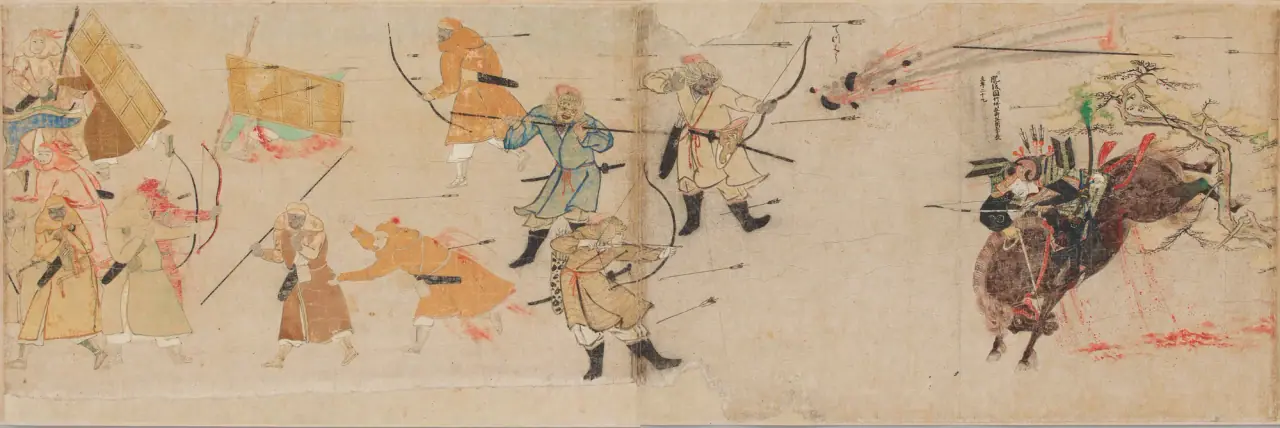
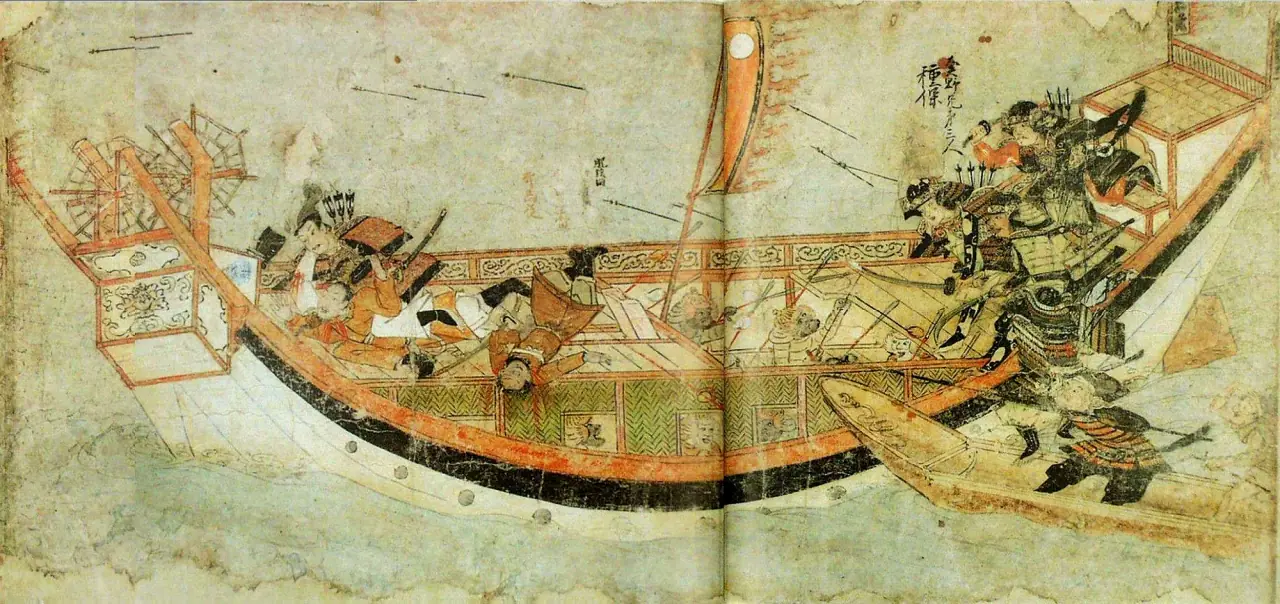
Whether a warrior obtained land depended on service, connections, litigation, and evidence that could prove merit. The Kamakura regime took shape gradually after the Genpei War; the appointments of shugo and jitō in 1185 and the appointment of the shogun in 1192 represent different stages, while the Kyoto court and temples and shrines still held rights. The Hōjō regency later became a key center, and land disputes and inheritance issues entered warrior law. In 1274 and 1281, Yuan and Goryeo and other forces attacked, drawing Kyushu residents, gokenin, and logistics workers into defense. The Mongol Invasion Scrolls make warrior self-presentation visible, and also remind us that the scrolls are both precious records and objects that have suffered damage, been reordered, and been worked on by later hands.
01 / 1185-1333How this era began
Warriors of the late Heian period were already connected to estate management, local security, and court offices; they did not suddenly appear from outside society. The Genpei War changed military alliances, and the victors needed to confirm relationships of land and followers while also obtaining political recognition from Kyoto. The interlocking rights of temples and shrines, aristocrats, and local residents meant that the new regime faced multiple jurisdictions from the start, not a blank map that could be redrawn.
Why did this era begin?
Minamoto no Yoritomo established household and judicial organs at Kamakura, and the appointments of jitō and shugo linked military service to land governance. 1185 and 1192 each have institutional significance; one cannot arbitrarily choose a single day as the founding of all institutions. The Minamoto shogunal family was unable to maintain power directly over the long term, and the Hōjō family held the core through the regency and council arrangements, so the title of shogun and the actual decision-makers gradually separated.
02 / 1185-1333Who held power
The shogunate could adjudicate disputes among gokenin, but the Kyoto court still held estates, ceremonial functions, and political resources, and local enforcement also depended on specific warriors. After the Jōkyū War of 1221, the shogunate's intervention in western lands and the court increased, but multiple rights did not simply disappear. To describe the entire era as "the emperor only handled rituals and the shogun managed everything" would miss the actual power in the regency, temples and shrines, and local relationships.
What tensions existed within the era?
Interlocking land rights easily led to long litigation, and property division and borrowing left some gokenin in difficult circumstances. The two foreign attacks and sustained defense increased the burden, and disputes over rewards were only one part of it. The court's attempts to reorganize authority, the Hōjō's internal concentration, and local warriors' choices interacted; the fall of the shogunate cannot be reduced to "after a typhoon, the warriors got no money."
03 / 1185-1333How society worked
Land revenues supported warrior service, and inheritance division, debt, and litigation constantly reorganized family property. Rural production, markets, and overseas trade did not stop under warrior rule, and military service and garrison duty consumed resources. Defensive wars rarely brought new conquered land to distribute, but that does not mean no one received rewards; the documents of Takezaki Suenaga clearly preserve the specific exception of his receiving Kaitōgō in 1276.
How did ordinary people live?
Peasant households maintained cultivation and responded to the demands of different rights-holders; warrior families managed land, arranged marriages, and prepared for service; monks preached to new believers. The war along the Kyushu coast was not borne only by famous mounted commanders; it also required ships, food, and people to build defensive works. Clothing, weapons, and actions in the scrolls provide clues, but as material for claiming merit and commemoration, they highlight the experiences the patron wanted to be seen.
04 / 1185-1333Where change began
Emperor Go-Daigo allied with anti-Hōjō forces, and warriors such as Ashikaga Takauji switched sides, causing the Kamakura regime to collapse in 1333. Joint opposition to the Hōjō did not mean the victors agreed on who should rule, and the brief Kenmu Restoration then fell into conflict. The political change did not end the relationship between land management and warrior service; rather, it carried those relationships into the split of the court and new shogunate combinations.
Milestones that changed direction
1185: Warrior land and security arrangements
Appointments after the Genpei War expanded Kamakura's influence, and friction remained among shugo, jitō, and existing land rights.
1192: Minamoto no Yoritomo receives the title of shogun
The confirmation of the title and the earlier formation of institutions are different stages; the founding of the shogunate cannot be compressed into a single ceremony.
1221: Jōkyū War
After the war between court and shogunate, Kamakura's intervention in Kyoto and western lands increased, but multiple rights still existed.
1232: Goseibai Shikimoku
Warrior judicial rules dealt with jitō, shugo, land, and inheritance issues, and the normative articles must still be read alongside enforcement cases.
1268: Mongol state letter reaches the court
The state letter, transmitted through Goryeo, the Dazaifu, and Kamakura, provoked reactions among Kyoto aristocrats; copies of diplomatic documents and contemporary diaries provide different evidence.
1274: First invasion of northern Kyushu
Yuan and Goryeo and other forces attacked Tsushima and Iki and reached the Hakata area, and island residents and coastal society endured the war.
1276: Takezaki Suenaga receives Kaitōgō
Later documents look back on the fact of receiving land for the Bun'ei campaign, showing that insufficient rewards cannot be generalized as no one receiving anything.
1281: Second attack and defense
Stone defensive works, patrols, and storms all entered the course of events; "divine wind" alone cannot replace the full explanation.
1333: Collapse of the Kamakura regime
The anti-Hōjō alliance won but did not reach a stable agreement on subsequent rule, leaving conflict for the Kenmu Restoration and the split of the court.
What we know
The 1232 Goseibai Shikimoku provided norms, but actual disputes still required documentary cases. The state letters and diaries preserved by the National Archives of Japan show the diplomatic transmission of 1268, and the Sannomaru Shōzōkan explains that the scrolls have misplaced pages, omissions, and intrusions. Takezaki Suenaga's dedication document links postwar land, villagers, and temples and shrines; comparing these different materials is more reliable than reconstructing the entire course of battle from a single famous combat painting.
Questions still debated
The shogunate's origins, its relationship with Kyoto, and the impact of the Mongol attacks all have differing interpretations. Storms did affect the outcome in 1281, but defensive preparations, combat, and logistics must also be analyzed, and the account of weather in 1274 cannot simply be carried over. The scrolls contain both near-contemporary material and later additions, so research should specify the version used and cannot directly call reconstructed images in a digital display an unaltered thirteenth-century original.
Legacies for later generations
The connection between warrior adjudication, service, and land rights deeply influenced medieval institutions, and religious and artistic patronage no longer centered only on Kyoto aristocrats. The Mongol attacks were later shaped into memories of a "divine wind" and national protection, but this later narrative cannot replace concrete analysis of the battlefield, defense, and weather. The people from Mongol, Han, and Goryeo and other sources also cannot be compressed into a single unchanging external ethnic enemy.
References and evidence
These materials support this page's account. Check the purpose, perspective and accessible scope of each source. Notes identify the evidential limits of excerpts, summaries and timelines.
- Kamakura and Nanboku-cho periodsThe Metropolitan Museum of Art · Museum research
Warrior power, the Mongol invasions, and Buddhist art; 1185 and 1192 represent different founding nodes.
- Japan: A Country Study (1992 edition), Historical Background chapterFederal Research Division, Library of Congress; edited by Ronald E. Dolan and Robert L. Worden · Specialist reference
Actually read the relevant passages of the 1992 edition's historical chapter: PDF pages 49–62, 64–80, and 81–110, and sampled the social environment section on PDF pages 129–132; the research mainly runs through 1990. The book's old Yayoi dating, some ethnic classifications, and several dates are clearly outdated or erroneous; errors such as the atomic bomb in 1941/August 8 and Kwantung Army losses of 80,000 were not adopted; precise dates and causation were checked against updated archaeology, NDL, and institutional materials. Makes no claim to have read all 670 pages or to treat old statistics as 2024 current conditions.
- Thirteenth-century Japan–Mongol relations: state letters, diaries, and picture scrollsNational Archives of Japan · Archive
Actually read the sections on the delivery of state letters, the Konoe diary, and the two invasions; the museum display includes later copies, and military figures and picture-scroll captions are not treated as an unselected complete picture.
- Collection and edition notes on the Mongol Invasion ScrollsImperial Household Agency Sannomaru Shozokan · Museum research
Read the descriptions of the two 13th-century scrolls and the issues of misplaced sections, losses, and later insertions; do not treat all later copies or restored images as original eyewitness records.
- Takezaki Suenaga's petition and testamentAgency for Cultural Affairs, Japan Cultural Heritage Online · Archive
Read the descriptions of the 1293 and 1314 documents, which mention the 1276 grant of Kaito County reward for service in the Bun'ei campaign; this counters the absolute claim that 'all gokenin received no reward at all.'
At the end, bring this chapter to a close.