Kofun and Yamato: piling power into mountains
How much labor and what kind of alliance did one huge burial mound require?
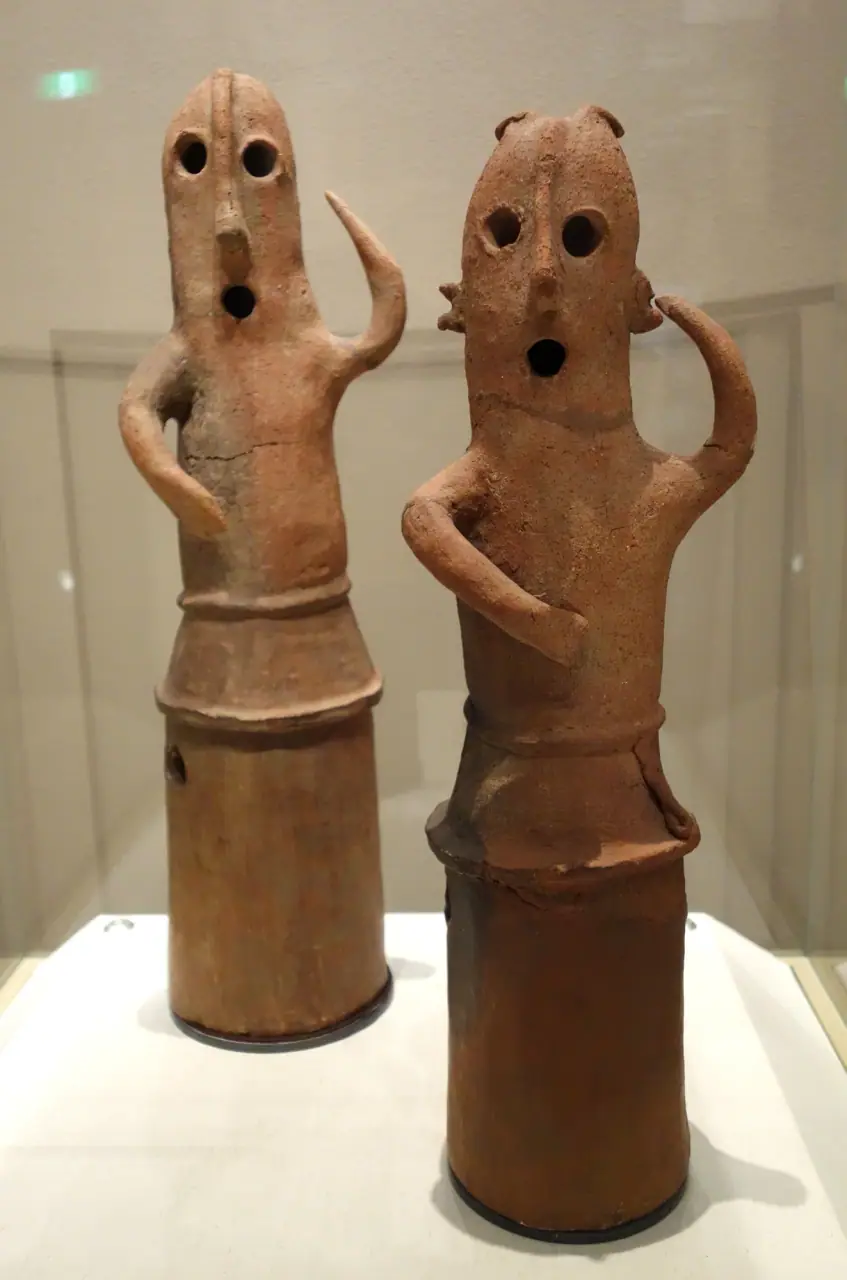
The large kofun visible from the Osaka Plain turned power into earthworks capable of occupying the landscape. From the third to sixth centuries, burial mounds of different sizes, buried mirrors and swords, horse trappings, and haniwa show both hierarchy and connections among elites; alliances in the Yamato region gradually gained the advantage. Such a process depended on mound builders, farmers, potters, and cross-sea technicians, not a tidy founding of a state in a king list. Kofun is a periodization of burial culture and can overlap with the Asuka period after the introduction of Buddhism in 538. Traditional imperial tomb names, the royal lineage narrative compiled in the eighth century, and archaeological identification of specific tomb occupants must be read separately.
01 / About 250–600 CE (burial culture overlapping with the Asuka period)How this era began
By the late Yayoi period there were already agriculture, storage, metal technology, and regional political networks, and the conditions for elites to organize resources had long existed. The new form of large tomb was not suddenly imported whole from outside, but was selected and developed through exchange between the archipelago and the peninsula. Treating early records of a queen directly as the occupant of a particular later keyhole tomb still requires bridging gaps between different dates and types of evidence.
Why did this era begin?
Mound forms, burial assemblages, and their expanding distribution allow researchers to trace elite interaction and organizational capacity. Shared forms such as keyhole tombs can express alliance membership without necessarily meaning that tomb occupants obeyed central commands of equal strength. Ironworking, horse trappings, ceramics, and written knowledge from the continent and the Korean Peninsula entered through the movement of people; transmitters of technology should be treated as actors, not merely abstract arrows of foreign influence.
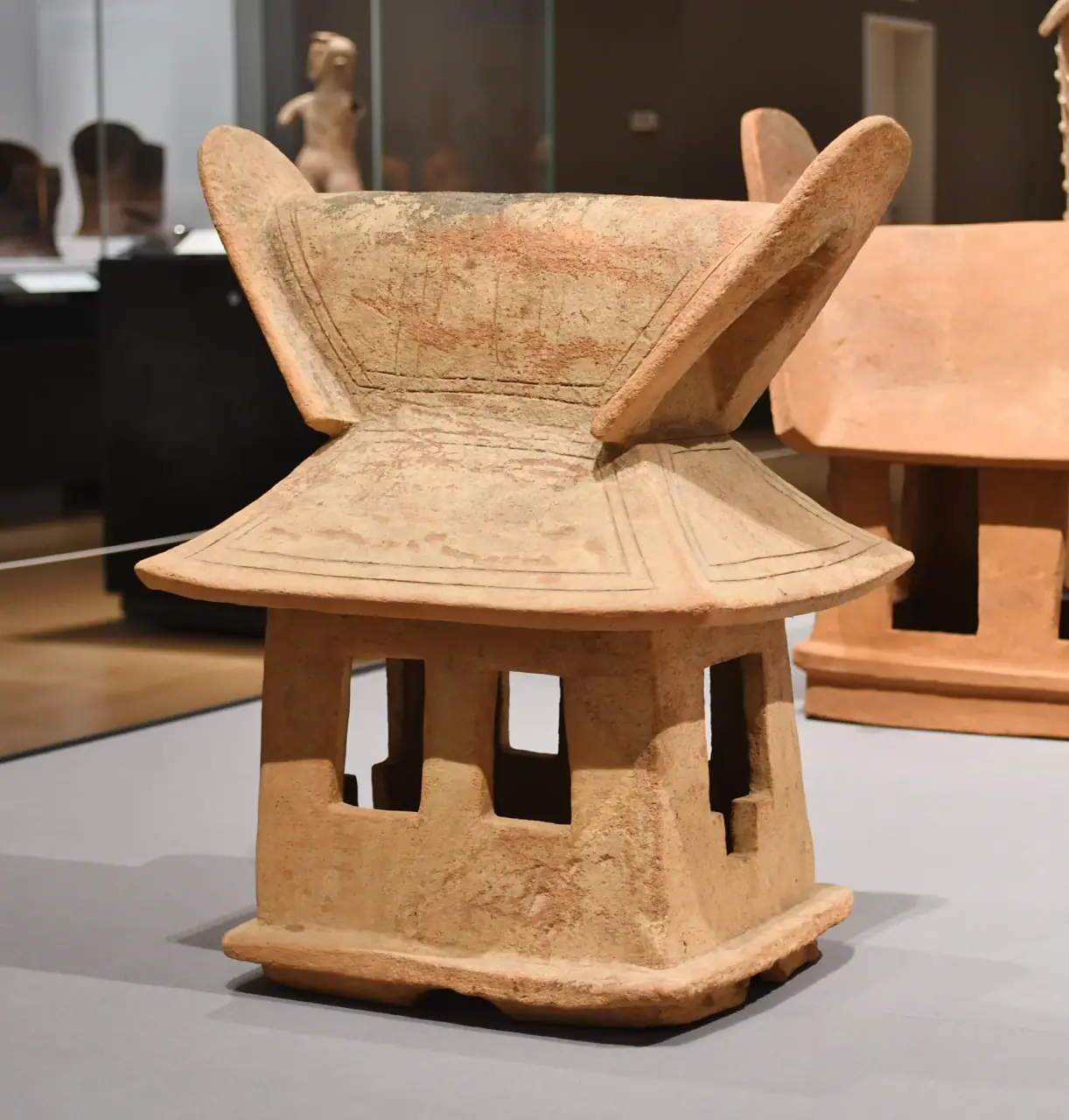
02 / About 250–600 CE (burial culture overlapping with the Asuka period)Who held power
The Yamato royal power expanded influence through clans, marriage, titles, and military ties, while local elites still had their own resources. The difference between huge tombs and small graves is important evidence of hierarchy and cannot be converted directly into a later table of official ranks. Some tombs are managed today by the Imperial Household Agency, and their traditional names have institutional and ritual significance; this management status does not automatically answer who is in the tomb or how large the actual realm of rule was.
What tensions existed within the era?
Large tombs can express alliances, but they may also record inequality in wealth and mobilizing capacity. Diplomatic ties, migration, and conflict existed between the polities of the archipelago and the political entities of the Korean Peninsula; ancient exchanges cannot be used to lend legitimacy to modern colonial arguments. Older scholarship that directly labeled a certain place on the peninsula as Japanese territory requires stricter textual and archaeological scrutiny; this chapter does not use titles or grave goods to assert modern-style territorial boundaries.
03 / About 250–600 CE (burial culture overlapping with the Asuka period)How society worked
Building tombs required earthwork, stone, timber, ceramic haniwa, and people to transport food, so the burial landscape also shows a capacity to concentrate agricultural produce and labor. Around the fifth century, the high-temperature kiln firing and potter's wheel technique of Sue ware were linked to peninsula crafts and changed part of object production. Elite grave goods are preserved conspicuously, while everyday farm tools and ordinary dwellings are not necessarily equally abundant; luxurious tomb chambers cannot be taken as evidence that everyone lived in wealth.
How did ordinary people live?
Haniwa depict houses, horses, animals, weapons, and people, leaving clues about dress and activity, but their forms also served funerary ritual and cannot be equated with a complete catalogue of life. Rural households maintained cultivation and dwellings, while specialist craftsmen worked in pottery, metal, and weaving. The house haniwa in the museum is a model object made in antiquity, whereas the reconstructed houses in the site park are modern interpretation; images must clearly distinguish the two.
04 / About 250–600 CE (burial culture overlapping with the Asuka period)Where change began
In the sixth century, Buddhism, writing, and new competition at court gradually linked expressions of power to temples and documents; burial traditions continued, while the capital and the ritsuryō system took shape over a longer period afterward. Here the Kofun culture narrative is extended to about 600 CE to accommodate sixth-century materials such as haniwa, and it overlaps with the Asuka chapter. The traditional dates of transmission in 538 or 552 CE cannot have caused all of society to stop building tombs at once.
Milestones that changed direction
About the second half of the third century: large keyhole-shaped tombs appear
Shared mound shapes and burial assemblages become materials for observing links among regional elites; specific tomb occupants cannot be confirmed solely from later royal genealogical narratives.
About the fourth century: grave goods and hierarchical differences
Mirrors, weapons, ornaments, and tombs of different scales can be compared, showing elite organization and resource distribution; a state's boundaries are not inferred from a single treasure.
About the fifth century: development of Sue ware kilns
High-temperature firing, the potter's wheel, and climbing kilns link to the Korean Peninsula; the movement of artisans and knowledge brought concrete changes in artifact production.
About the end of the fifth century: expansion of Yamato alliance influence
The Yamato region's advantage within elite networks becomes more evident, but local polities still had their own resources; this does not mean the entire archipelago already shared a single system.
538/552 CE: traditional dates for the introduction of Buddhism
Different traditional chronologies mark an important node in religious exchange between the peninsula and the archipelago; burial culture did not immediately end because of it.
About the sixth century: figural and animal haniwa
Representational haniwa bring clothing, houses, and animals into the funerary landscape; conventional names such as "dancing figures" do not equal known specific ritual content.
About the end of the sixth century: temples and tombs coexist
Early Buddhist architecture and older burial traditions overlap in time, showing that political and art-historical periodizations can overlap.
What we know
Mound surveys, stone chambers, haniwa, and excavated artifacts can be compared with one another, while unexcavated tombs limit judgments about the buried person and internal chronology. The eighth-century Kojiki and Nihon Shoki are separated in time from early kingship, and their compilatory purposes cannot be ignored. UNESCO places the kofun groups before the establishment of the centralized ritsuryō state; this chapter does not force the long periodization of art history and the narrower political periodization into a single precise chronology.
Questions still debated
The discussion focuses on how the Yamato alliance formed, the relationship between local chiefs and the center, and the role played by peninsular technologies and immigrants. Shared mound shapes can support the idea of connections, but similar artifacts alone cannot prove a single ethnicity or a comprehensive conquest. Traditional attributions of tomb occupants and what archaeology can confirm may differ; preserving that distinction is more consistent with the available evidence than assigning a definite name to every giant tomb.
Legacies for later generations
As landscape, kofun preserve the early ways of organizing labor and displaying difference, while horse trappings, kiln industries, and artifacts show that the archipelago was never an isolated space of development. Today tombs are part of narratives about the imperial family, localities, and cultural heritage, but the scope of modern protection does not equal the boundaries of ancient polities. Asking about the labor beneath the tombs and about connections in many directions helps move beyond a perspective that explains every object solely through royal origins.
References and evidence
These materials support this page's account. Check the purpose, perspective and accessible scope of each source. Notes identify the evidential limits of excerpts, summaries and timelines.
- Kofun period and Yamato powerThe Metropolitan Museum of Art · Museum research
Actually read the full main text and checked haniwa, burial goods, fifth-century Sue ware, and Korean Peninsula kiln technology; the museum's art-history heading of about 300–710 is not used as the sole periodization of tomb culture and is cross-checked separately against UNESCO's third- to sixth-century tomb groups.
- Mozu-Furuichi Kofun Group: Statement of Outstanding Universal ValueUNESCO World Heritage Centre · Specialist reference
Actually read the text on value, integrity, and authenticity; tombs of the 3rd–6th centuries, hierarchy, and civil engineering. Current imperial tomb management and traditional tomb-attribution names do not equal archaeological confirmation of the tomb occupant.
- Japan: A Country Study (1992 edition), Historical Background chapterFederal Research Division, Library of Congress; edited by Ronald E. Dolan and Robert L. Worden · Specialist reference
Actually read the relevant passages of the 1992 edition's historical chapter: PDF pages 49–62, 64–80, and 81–110, and sampled the social environment section on PDF pages 129–132; the research mainly runs through 1990. The book's old Yayoi dating, some ethnic classifications, and several dates are clearly outdated or erroneous; errors such as the atomic bomb in 1941/August 8 and Kwantung Army losses of 80,000 were not adopted; precise dates and causation were checked against updated archaeology, NDL, and institutional materials. Makes no claim to have read all 670 pages or to treat old statistics as 2024 current conditions.
- Buddhist Monuments in the Horyu-ji Area: History and ConservationUNESCO World Heritage Centre · Specialist reference
Actually read the account of the original buildings' 670 fire, late 7th- to 8th-century reconstruction, and modern repairs. Extant buildings cannot all be retro-dated uniformly to 607, and modern restoration must be retained.
- Asuka and Nara periodsThe Metropolitan Museum of Art · Museum research
Buddhism, Chinese characters, capitals, and taxes and corvée; the introduction of Buddhism has two chronological dates, 538 and 552.
At the end, bring this chapter to a close.