Bakumatsu and Meiji: Reorganizing a nation
How did new schools, tax bills, and conscription orders enter every household?
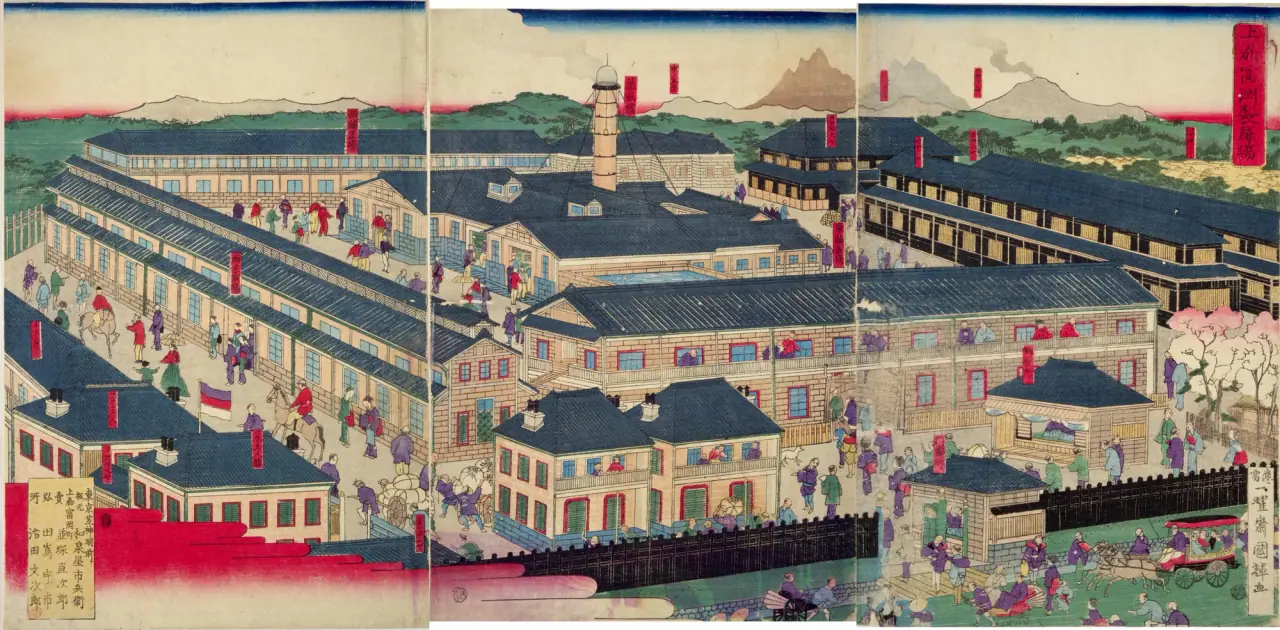
Perry's fleet and the unequal treaties deepened the shogunate's crisis of rule, but the overthrow of the shogunate was not the only outcome naturally produced by external pressure. The court, the domains, and various political groups contended for power; the new regime was established in civil war in 1868, and the subsequent abolition of the domains, conscription, tax reform, and promotion of education brought households more directly into central institutions. Railways and silk-reeling mills brought technology and work, but also new fiscal and labor burdens; the people demanded a parliament, while the government restricted opposition activity. The colonial development of Hokkaido and the end of the Ryukyu Kingdom remind us that the formation of the modern state also changed the land, culture, and political rights of those incorporated into it.
01 / 1853–1890How this era began
The shogunate had previously encountered the wider world through Nagasaki and surrounding regions, and the domains also had differing experience of fiscal and military reform. Foreign gunboats and the situation of war in East Asia made the existing coastal defense arrangements difficult to maintain, while poor harvests, debt, and local discontent weakened the regime's capacity for coordination. The question was not only whether to accept Western technology, but also who would decide treaties, taxation, and the name of rule, and how the costs of change would be borne.
Why did this era begin?
The 1854 Treaty of Amity and the 1858 Treaty of Commerce were different in nature: the former arranged matters such as supplies, while the latter expanded trade and involved extraterritoriality. The shogunate's handling of commercial relations without the court's consent intensified debate, and the anti-shogunate alliance took shape through both armed force and political negotiation. The 1867 restoration of imperial rule did not immediately settle where power lay; the following year, the new government and the Boshin War turned institutional debate into nationwide reorganization.
02 / 1853–1890Who held power
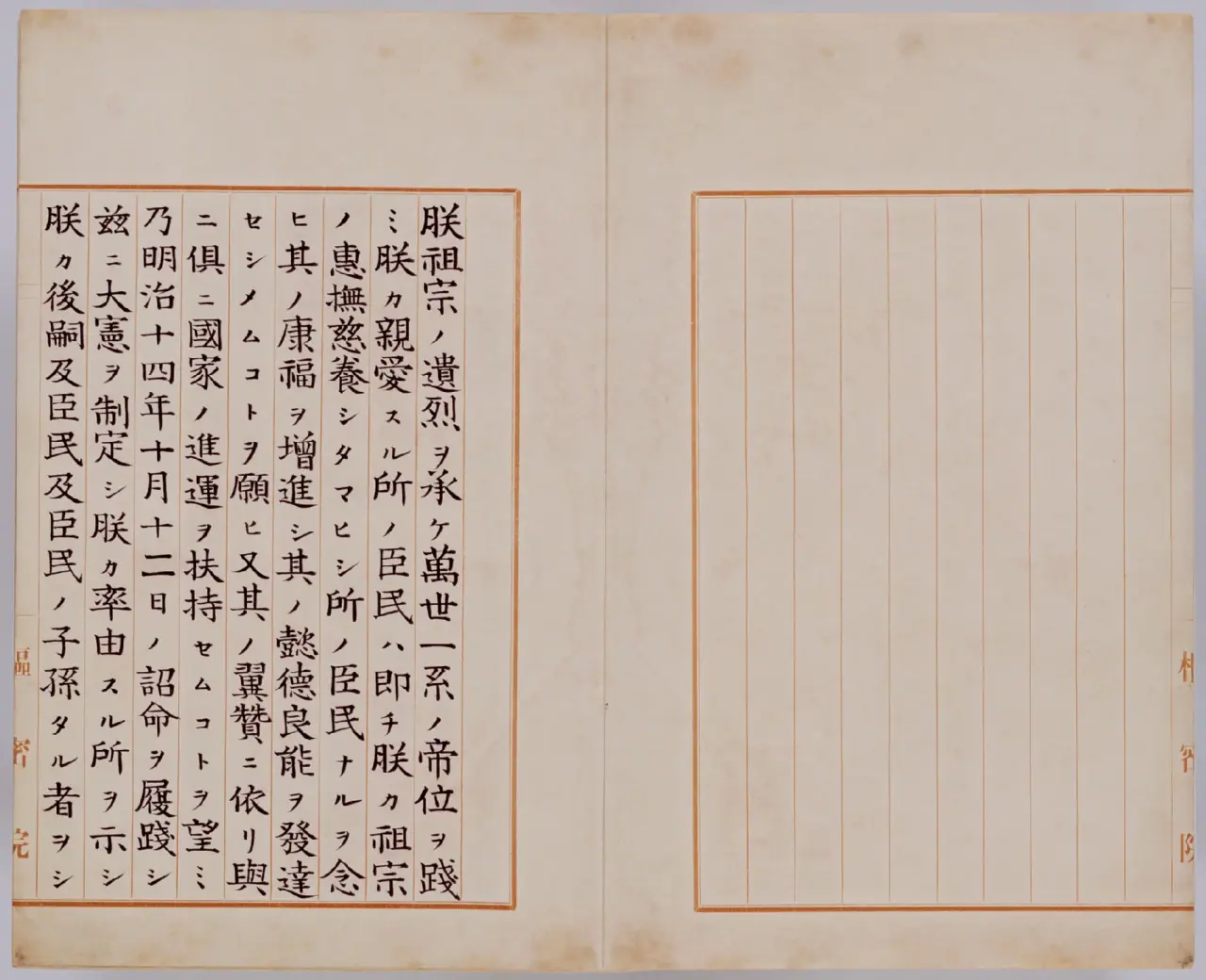
The new government made the emperor the center of legitimacy, while domain-clique leaders and central bureaucrats controlled policy; the 1871 abolition of the domains and establishment of prefectures weakened the old lordly system, and conscription and schools further changed the relationship between state and household. The 1889 constitution set out the emperor's powers and a parliamentary framework, and the Imperial Diet opened in 1890, but restrictions based on tax payment, gender, and other criteria meant that the initial electorate was only a minority, and rights were also constrained by legal reservations.
What tensions existed within the era?
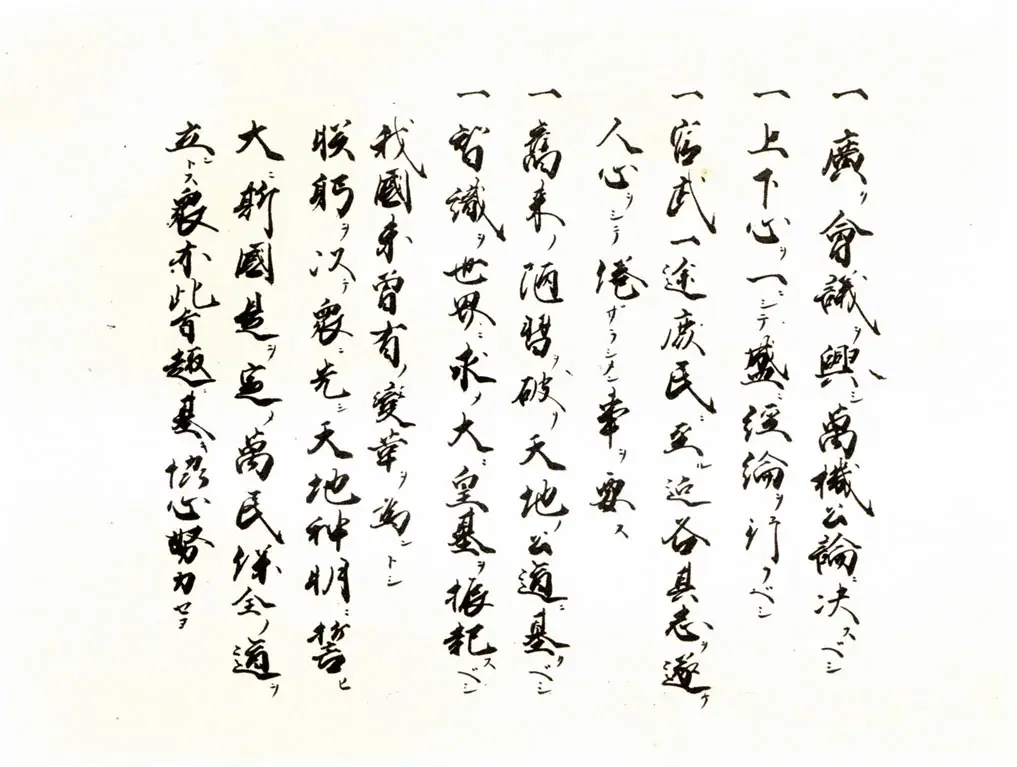
Former samurai lost stipends and status privileges, and peasants were also dissatisfied with the tax burden, conscription, and school fees; the government did not face only one kind of conservative resistance. The Freedom and People's Rights Movement demanded a parliament and a constitution, but faced restrictions on assembly, the press, and the police system. The incorporation of Hokkaido and Ryukyu involved transfers of land and political power, and what the center called unification may have meant the loss of existing autonomy and cultural space for local people.
03 / 1853–1890How society worked
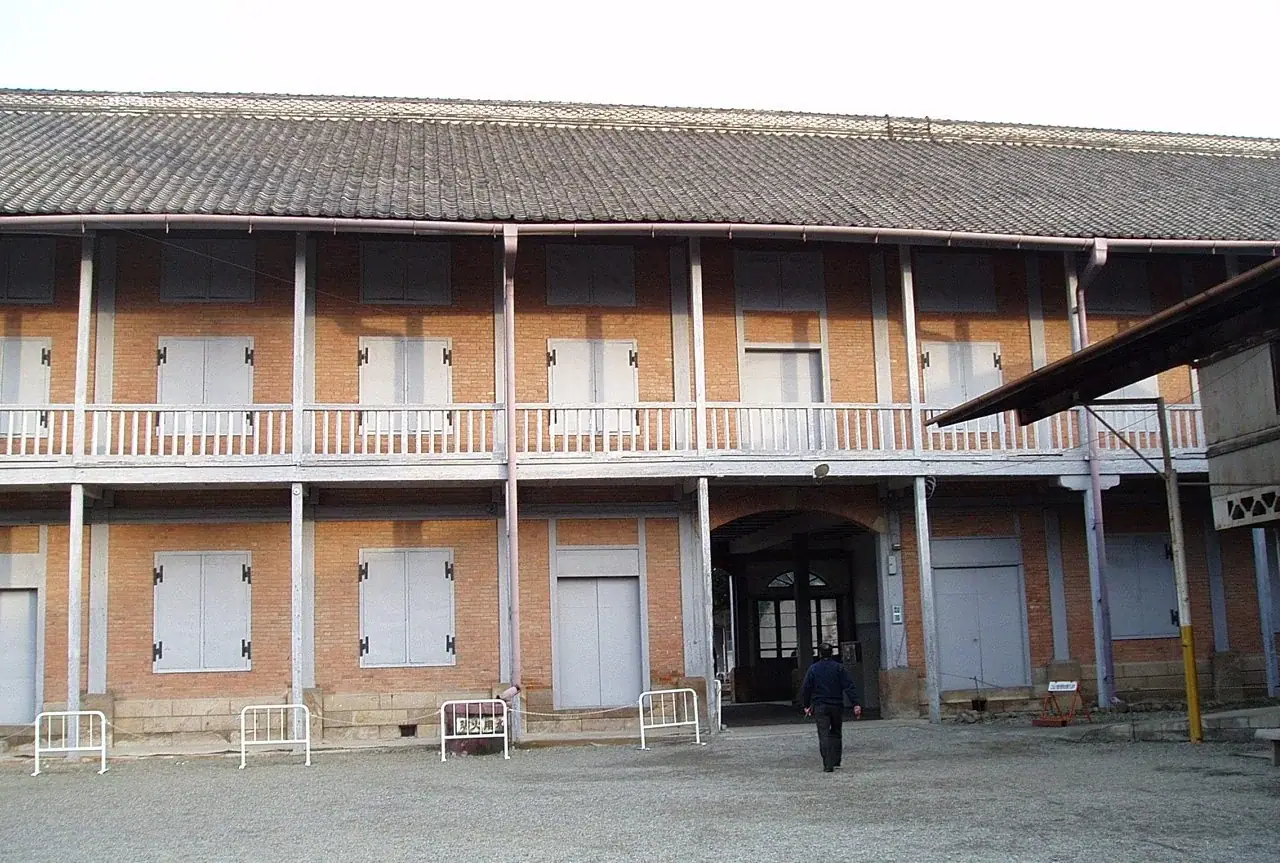
Land tax reform required payment in money, enabling the government to establish relatively stable finances, while agricultural households bore the pressure of price fluctuations and raising cash. Railways, telegraphs, and government-run factories absorbed foreign equipment and knowledge, and the Tomioka silk mill linked sericulture, mechanical silk reeling, and export markets. The spread of technology depended on engineers, female workers, and rural producers, and should not be summarized only as the success of state investment or a few entrepreneurs.
How did ordinary people live?
Households faced new demands for conscription, schooling, calendar reform, and tax payment; young people entered barracks, schools, or factories, gaining new room for action while paying the cost in income and care arrangements. Women's education and Tsuda Umeko's experience abroad show that gender rules could be challenged, but this does not mean that most women already enjoyed equal opportunities. Village opposition to the tax system or schools must also be understood in the context of specific livelihoods.
04 / 1853–1890Where change began
In the 1880s, under pressure from the people's rights movement, the government advanced constitutional government while defining the boundaries of participation through imperial sovereignty and independent administrative power. The cabinet system, the constitution, and the parliament were established in succession, making the structure of rule more stable, but they did not resolve the problems of finance, control of the military, and colonial expansion. The chapter ends at the institutional starting point of 1890, not with a declaration that modernization was complete; later industrialization and empire must continue to ask who obtained rights.
Milestones that changed direction
1853: The arrival of the Black Ships
The U.S. fleet arrived at Uraga and demanded the establishment of diplomatic relations; naval deterrence made the shogunate's authority over foreign policy a domestic controversy.
1854: Signing of the Treaty of Kanagawa
The Japan-U.S. Treaty of Amity arranged supplies at Shimoda and Hakodate and the treatment of castaways; it should be distinguished from the 1858 Treaty of Commerce that expanded trade.
1858: Japan-U.S. Treaty of Amity and Commerce
The treaty expanded trade through opened ports, and arrangements such as extraterritoriality and its signing without the court's permission intensified the shogunate's political crisis.
1867: Restoration of imperial rule
Tokugawa Yoshinobu proposed returning power to the court, but this did not immediately eliminate conflict over the leadership of the new government.
1868: The new government and the Boshin War
The restoration of imperial rule formed a new regime, and opposing forces and the new government's army fought a civil war; national reorganization was not a peaceful paper declaration.
1871: Abolition of the domains and establishment of prefectures
The center reorganized local administration; that same year the Iwakura Mission went abroad, making institutional study and treaty revision part of nation-building.
1872: The Tomioka silk mill begins production
French equipment and instructors took part in government-run mechanical silk reeling, and female workers, sericultural households, and export markets together supported the spread of technology.
1873: Conscription and land tax reform
National military service and a monetary land tax brought state demands directly into households, and the benefits of reform and the costs to livelihoods were not the same.
1879: The end of the Ryukyu Kingdom
Armed forces entered Shuri in March and the establishment of Okinawa Prefecture was announced in April; the Ryukyuan side had continued negotiations, and the takeover cannot be written as wholly voluntary.
1889: Promulgation of the Meiji Constitution
A constitutional framework was established under imperial sovereignty, and the first election and the opening of the Imperial Diet followed the next year; limited participation coexisted with administrative and military power.
What we know
Treaties, tax laws, parliamentary petitions, and constitutional drafts allow comparison of different political choices; official promulgation did not mean that the grassroots immediately accepted them. The equipment, buildings, and production records at Tomioka reveal technological networks, while the experiences of female workers and farming households still require labor records to supplement them. The Okinawa Prefectural Archives preserves both the orders for forced takeover and traces of Ryukyuan negotiation, helping to correct a narrative of national unification viewed only from Tokyo.
Questions still debated
Researchers debate whether the Restoration was closer to a revolution, an elite reorganization, or a long-term institutional transformation, and different answers often depend on whether one observes political power or grassroots life. Evaluations of "successful modernization" must separate wealth and military strength, social rights, and colonial costs; inferring from the later empire back to 1868 as leading only to aggression would also ignore the choices of civil rights, diplomacy, and constitutional government that still existed at the time.
Legacies for later generations
The schools, bureaucracy, military, and infrastructure established in the Meiji period profoundly changed society, and parliamentary politics also gained institutional space for sustainable development. At the same time, colonial incorporation, patriarchal family norms, and loyalist education wrote exclusion into nation-building. One cannot attribute all change to elites, nor use the outcome of aggression to erase the actual efforts of rights activists, workers, and educated women to seek different paths.
References and evidence
These materials support this page's account. Check the purpose, perspective and accessible scope of each source. Notes identify the evidential limits of excerpts, summaries and timelines.
- Chronology of modern Japanese archivesNational Diet Library of Japan · Archive
Checked political nodes from 1853 to the postwar period and can link to individual archival items. Lunar and Gregorian dates are listed together; this draft uses Gregorian years.
- Black Ships and samuraiMIT Visualizing Cultures · Academic research
Read the main introduction of bss_essay01 and public sections such as the character-image comparison in bss_essay02, checking the 1853 arrival, gunboats, and different visual representations. No claim is made to have read all nine sections or obtained commercial permission for their CC BY-NC-SA images; the local image library is separately reviewed from independent open sources.
- Japan: A Country Study (1992 edition), Historical Background chapterFederal Research Division, Library of Congress; edited by Ronald E. Dolan and Robert L. Worden · Specialist reference
Actually read the relevant passages of the 1992 edition's historical chapter: PDF pages 49–62, 64–80, and 81–110, and sampled the social environment section on PDF pages 129–132; the research mainly runs through 1990. The book's old Yayoi dating, some ethnic classifications, and several dates are clearly outdated or erroneous; errors such as the atomic bomb in 1941/August 8 and Kwantung Army losses of 80,000 were not adopted; precise dates and causation were checked against updated archaeology, NDL, and institutional materials. Makes no claim to have read all 670 pages or to treat old statistics as 2024 current conditions.
- Tomioka Silk Mill and Related SitesUNESCO World Heritage Centre · Specialist reference
Check the full network of early Meiji French machinery and technology, silk reeling, sericulture education, and silkworm egg storage; the success narrative of the heritage site does not represent all factory labor conditions.
- English Translation of the Original Text of the Constitution of the Empire of JapanNational Diet Library of Japan · Primary source
Actually read the provisions on sovereignty, supreme command, the diet, and subject rights; the provisions show the formal arrangement of power and do not equal how every decision was actually made.
- 1879: The end of the Kingdom of Ryukyu and the establishment of Okinawa PrefectureOkinawa Prefectural Archives · Archive
Actually read the main text and document descriptions; distinguish the armed entry into Shuri on March 27, the national proclamation on April 4, and the earlier establishment of the Ryukyu Domain in 1872, while preserving Ryukyuan opposition and negotiations.
- Tsuda University: Founder and HistoryTsuda University · Academic research
Checked Tsuda Umeko's transnational study and the 1900 Women's English School; the institution's self-account should be cross-checked against research on women's education history.
At the end, bring this chapter to a close.