01 / CONTEXT & CONSEQUENCEBefore the event
Disputes over slavery in new territories, the pursuit of fugitives from slavery and political representation repeatedly shook the Union. Existing compromises could not satisfy competing demands for future expansion. Racism existed in the North, and not every southern resident supported slaveholders' rule. Explaining war requires analysis of the connections among enslaved property, labor and political power rather than simply classifying two cultures as modern and backward.
Slavery was more than a labor system: it shaped property, racial power and national expansion. Arguments about state and federal powers must be understood through the specific question of preserving or restricting slavery. They cannot serve as an independent overarching cause detached from slavery. Markets and regional differences affected resources for war, but do not adequately explain why the crisis erupted around secession by slave states.
02 / CONTEXT & CONSEQUENCEHow change unfolded
After Lincoln's election in 1860, southern slave states successively declared secession, intensifying disputes over federal facilities and sovereignty. The attack on Fort Sumter in April 1861 brought the crisis into a phase of war and mass mobilization. Secession and the outbreak of war were specific political actions, not mechanical consequences of an election result. Decision-makers remained responsible for their choices and aims.
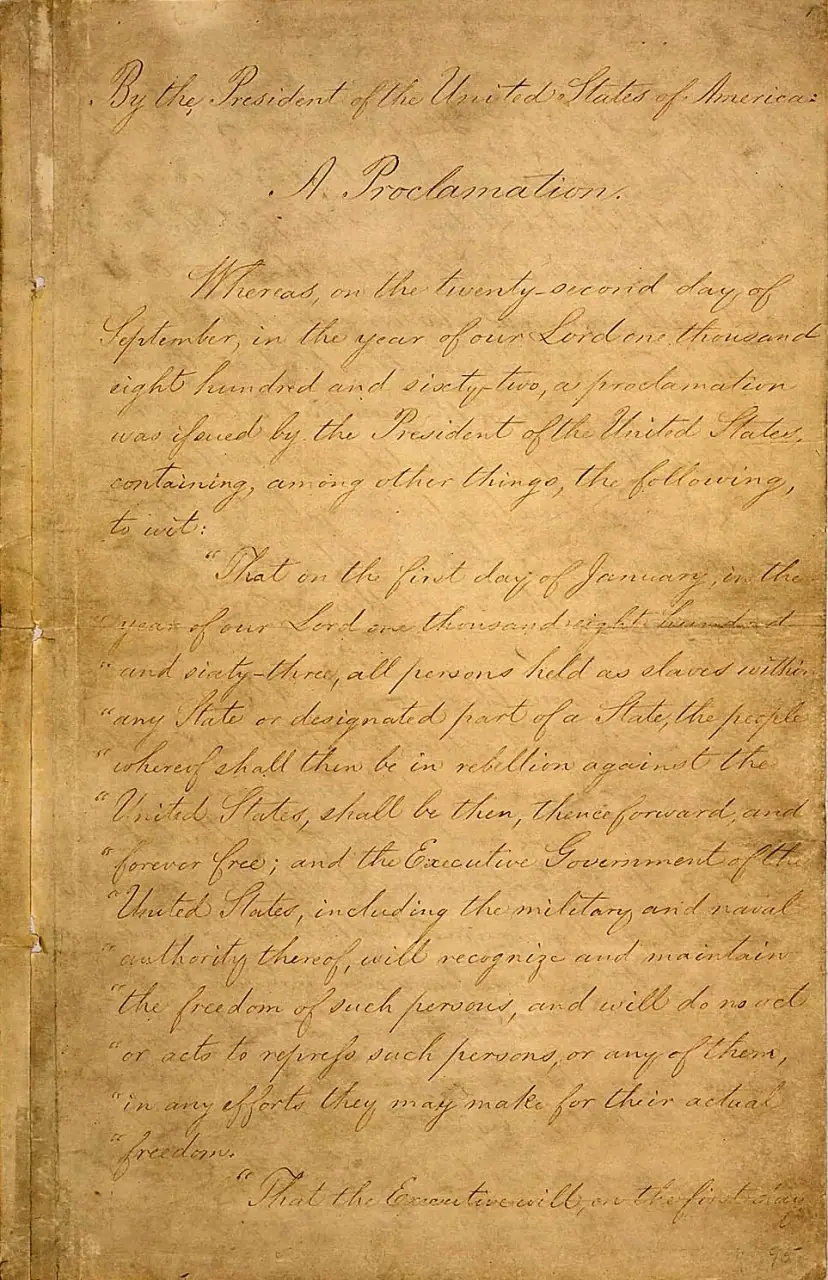
The Union initially prioritized national unity, while people escaping slavery and abolitionist forces pressed for change. The preliminary proclamation of 1862, the formal proclamation of 1863 and Black enlistment tied military action more closely to emancipation. Union advances expanded actual freedom. Confederate military defeat ended the war, while constitutional amendment established nationwide abolition. These separate strands cannot be combined into a single unilateral gift.
03 / CONTEXT & CONSEQUENCEPeople, institutions and alternatives
Black people were not a passive population awaiting Lincoln's orders. Escape, reconnaissance, labor, rescue and military service changed the resources of war and the boundaries of freedom. Douglass promoted Black enlistment and citizenship, while Tubman and others took part in practical action. Presidents, officers and Congress held unequal formal powers, but a narrative confined to them cannot explain the pressures on policy or the conditions of implementation.
Compromise, gradual emancipation and different military strategies were debated at the time. Each proposal must be assessed for its protection of slaveholders' interests and recognition of enslaved people's agency. A hypothetical absence of war does not automatically mean a peaceful and equal future. Nor was Union victory certain when war began: military, resource and international conditions affected the range of feasible policies.
04 / CONTEXT & CONSEQUENCEAfter the turning point
War caused enormous casualties and dispersed families. Confederate defeat made nationwide legal abolition possible. The Thirteenth Amendment retained an exception for punishment following conviction. Formal termination of ownership in human beings did not resolve property, wages or personal safety. Freed people gained opportunities for action while facing renewed control by former slaveholders and local authorities. Reconstruction was therefore part of the war's consequences, not an unrelated sequel.
Abolition and subsequent citizenship amendments reshaped American institutions, while remembrance by veterans, households and communities influenced understandings of the war over time. Narratives of emancipation can highlight leaders or collective action; the relationship requires evidence. Racialized forced labor and violence after the war show that freedom depended on conditions of protection. Legal abolition does not make later inequality a merely accidental deviation.
How the event unfolded
The Civil War begins
The southern secession crisis became military conflict at Fort Sumter. The Union initially aimed to preserve unity, while slavery remained central to secession politics.
The preliminary Emancipation Proclamation
The preliminary proclamation stated that enslaved people in relevant areas would be emancipated the following year if rebellion continued. Policy, military developments and self-emancipation continually interacted.
Emancipation and enlistment
The proclamation specified both geographical limits and Black enlistment. Actual freedom depended on escape, military advances and personal action, not the announcement date alone.
Confederate defeat and the abolition amendment
The Confederacy was defeated. The Thirteenth Amendment established nationwide legal abolition while retaining a punishment exception. Land, wages and citizenship became subjects of Reconstruction struggles.
Facts supported by evidence
- The secession crisis following the 1860 election became civil war in 1861. Slavery was central to the politics of secession.
- The Emancipation Proclamation of January 1, 1863 applied mainly to rebellious areas and did not free every enslaved person nationwide that day.
- The proclamation announced acceptance of Black military service. Escape, labor and enlistment also shaped the practical course of emancipation.
- The Thirteenth Amendment abolished slavery and involuntary servitude nationwide in 1865, while retaining an exception for punishment following conviction.
Major historical interpretations
- State policy, military control and enslaved people's own actions jointly drove emancipation. It cannot be reduced to a gift from one president.
- Economic and states' rights differences must be explained through the specific institutions of slave property, labor and expansion.
Questions still discussed
- The relative roles of Lincoln's policies, military needs and social action are open to discussion. Slavery's central place in secession is well supported by evidence.
- Alternatives to war should be assessed for whether they protected enslaved people's freedom, rather than solely for whether white political elites could compromise.
Frederick Douglass
Abolitionist and writerAfter escaping enslavement, he advanced abolition through writing, speeches and organizing. During the Civil War he supported Black enlistment and demanded citizenship. He connected war with equality without treating government policy as the sole source of freedom. Personal experience, political strategy and community action jointly shaped his influence.
Harriet Tubman
Anti-slavery activist, scout and participant in rescue operationsAfter escaping enslavement, she returned repeatedly to help relatives and others obtain freedom. During the Civil War she participated in nursing, reconnaissance and rescue, and later supported women's rights and community care. Her life connects self-emancipation, military action and household rebuilding. It should not be reduced to a legend existing only during the Underground Railroad period.
References and evidence
These materials support this page's account. Check the purpose, perspective and accessible scope of each source. Notes identify the evidential limits of excerpts, summaries and timelines.
- The Causes of the American Civil WarU.S. National Park Service · Specialist reference
Slavery's central role in secession, alongside disputes over federal power and the economy.
- The Emancipation Proclamation (1863)U.S. National Archives · Primary source
Geographical scope, wartime context and Black enlistment. It did not abolish all slavery nationwide on the day of publication.
- Institutions and Society during ReconstructionU.S. National Park Service · Specialist reference
The Thirteenth through Fifteenth Amendments, freed people and gaps in institutional implementation.
- Frederick Douglass and the Civil WarU.S. National Park Service · Specialist reference
Dates of birth and death, anti-slavery activities, Black enlistment and demands for citizenship.
- Milestone Documents in American HistoryU.S. National Archives · Archive
A thematic navigation entry for locating materials. Specific dates and institutional conclusions are cross-checked against documents, collections and substantive entries listed in this chapter. A directory does not establish an account of an entire period.
- Original Text of the Thirteenth AmendmentU.S. National Archives · Primary source
The institution that produced a source and the nature of its text must be distinguished from what it describes. A source link does not mean that every related archive has been made public.
- Harriet TubmanU.S. National Park Service · Specialist reference
The institution that produced a source and the nature of its text must be distinguished from what it describes. A source link does not mean that every related archive has been made public.
- The Compromise of 1850: Resolutions and Five ActsU.S. National Archives · Primary source
Distinguish Clay's resolutions from subsequent statutes. Stronger provisions for recapturing fugitives from slavery did not end slavery.
- The Kansas-Nebraska Act (1854)U.S. National Archives · Primary source
Specific legislation concerning territorial politics and slavery. Statutory language of self-determination should not conceal violence or excluded people.