01 / CONTEXT & CONSEQUENCEBefore the event
After the Seven Years' War, Britain needed to service debt and maintain troops, while colonial assemblies sought to retain influence over revenue and local affairs. The two sides had previously shared imperial trading and military connections, rather than always being separate. The crisis concerned the rebuilding of postwar relations, not a people who had supposedly already agreed on independence within an American nation that did not yet exist.
Colonists had accumulated experience of local self-government while the empire sought more consistent fiscal and administrative control. Representation, property and trade interests became intertwined. Frontier expansion and Britain's arrangements for relations with Indigenous peoples also produced disagreements. The language of liberty connected different interests without automatically removing internal differences in enslavement, gender and power over land.
02 / CONTEXT & CONSEQUENCEHow change unfolded
The Stamp Act crisis of 1765, subsequent boycotts, the Tea Party and British punitive measures connected scattered disputes into mobilization across colonies. Fighting at Lexington and Concord in 1775 turned political confrontation into a military problem. Demands for reconciliation nevertheless survived the outbreak of war. The trigger was a sequence of escalation, not one street incident that can serve as a complete explanation.
The Continental Congress coordinated resistance and war. The 1776 Declaration publicly advanced independence, while local institutions and armies recruited soldiers, requisitioned food and governed. Alliance with France made the conflict part of a wider international war. The military situation at Yorktown and diplomatic negotiations helped produce the 1783 peace. Battlefields, finance and naval power constrained one another; listing a few victories cannot explain the outcome.
03 / CONTEXT & CONSEQUENCEPeople, institutions and alternatives
Washington and the Continental Congress mattered, but soldiers, militias, women, merchants and households also sustained the war. They could oppose requisitions or choose loyalty to Britain. Enslaved people sought paths to freedom, while Indigenous peoples formed alliances in relation to territorial security. Recognizing these actions means acknowledging that the revolution was not a common project in which every resident pursued the same national goal.
Greater autonomy within the empire, tax reform and mediation were imaginable alternatives. Even after 1775 some hoped to restore relations. As fighting, punishment and distrust escalated, compromise became more costly. Assessing alternatives requires explaining whose representation, labor and land problems they might resolve. Avoiding a war of independence cannot simply be equated with greater freedom for every group.
04 / CONTEXT & CONSEQUENCEAfter the turning point
Britain recognized American independence. The new country could establish its own diplomacy and governing institutions, but war debts and interstate cooperation remained difficult. Territorial arrangements in the peace did not secure the agreement of all Indigenous peoples, and slavery continued. Independence changed national status. Further institutions and action were needed to extend social equality and governing capacity.
The Declaration's language of rights entered abolitionist, women's and civil-rights movements, as previously excluded people demanded fulfillment of its promises. War and state-building also left experience of federal finance, civilian-military relations and party conflict. This legacy was not an unchanging set of founding intentions. It was a historical process of later generations arguing over the reach of texts, institutional powers and membership in the people.
How the event unfolded
War begins
After fighting at Lexington and Concord, the Continental Congress and local institutions needed to organize sustained supplies and military service. The outbreak of war still did not mean that all residents had accepted independence.
Independence declared
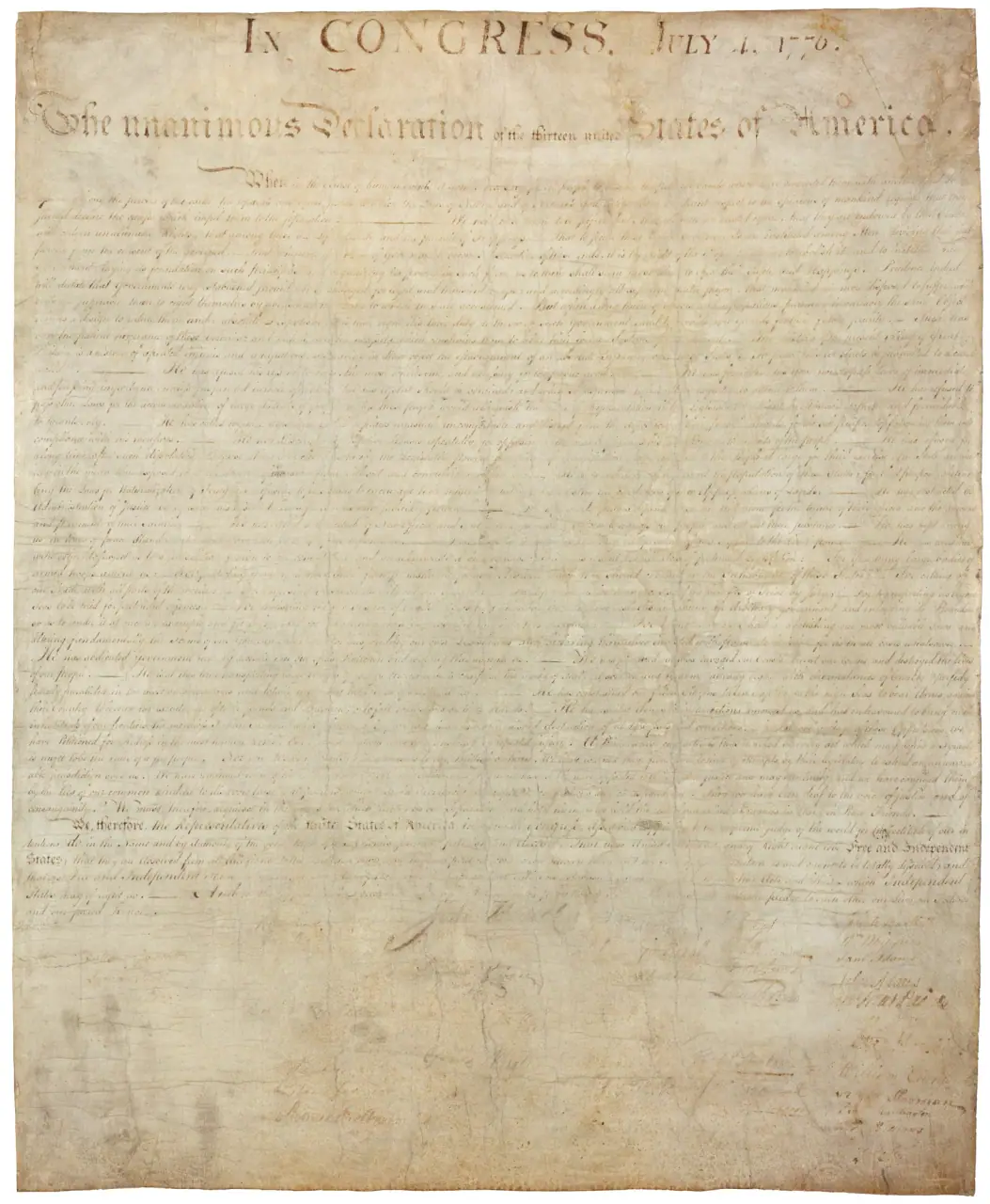
The Continental Congress adopted the Declaration, justifying independence through rights and the consent of the governed. Adoption, signing the parchment and realizing principles in society were different levels of the process.
Alliance with France changes the scale of war
French alliance supplied naval, material and diplomatic support and placed the North American war within wider imperial competition. The colonial army did not determine the result in isolation.
Independence recognized
Britain recognized American independence, while the peace treaty arranged territorial claims between states. Indigenous consent, war debts and the operation of government remained unresolved.
Facts supported by evidence
- The Continental Congress adopted the Declaration of Independence on July 4, 1776. The main signing of the parchment text began on August 2. Adoption and signing must not be conflated.
- France allied with the United States in 1778, extending the North American conflict within a wider international war.
- The Treaty of Paris in 1783 recognized American independence. Territorial arrangements among the treaty powers did not obtain the consent of all affected Indigenous peoples.
Major historical interpretations
- Independence emerged from crises in imperial governance, local mobilization and international warfare, rather than taxation alone or the personal will of leaders.
- The language of rights united revolutionary action and also gave later excluded groups resources with which to demand fulfillment of its principles.
Questions still discussed
- Assessing the revolution's social radicalism requires separate attention to property, gender, enslavement and Indigenous sovereignty. Groups did not share the same gains and losses.
- Explanations of the relative weight of elite interests, popular action and foreign assistance must specify their scale of comparison. Multiple causes should not become a list whose entries ignore differences in supporting evidence.
George Washington
Commander of the Continental Army and first presidentHe commanded the Continental Army during the Revolutionary War, subsequently helped establish the new federal government and became its first president. His leadership and civil-military precedents had lasting influence. He was also a slaveholder. Understanding the republic's language of freedom requires attention to his power, household economy and the circumstances of enslaved people, rather than preserving only an image of a founding hero.
References and evidence
These materials support this page's account. Check the purpose, perspective and accessible scope of each source. Notes identify the evidential limits of excerpts, summaries and timelines.
- The Declaration of Independence (1776)U.S. National Archives · Primary source
Original document, transcription and historical explanation. The Declaration's claims about rights do not mean that everyone actually enjoyed equality.
- Milestone Documents in American HistoryU.S. National Archives · Archive
A thematic navigation entry for locating materials. Specific dates and institutional conclusions are cross-checked against documents, collections and substantive entries listed in this chapter. A directory does not establish an account of an entire period.
- The New Nation, 1783–1815Library of Congress · Archive
A thematic navigation entry for locating materials. Specific dates and institutional conclusions are cross-checked against documents, collections and substantive entries listed in this chapter. A directory does not establish an account of an entire period.
- George Washington: Biographical InformationU.S. National Park Service · Specialist reference
Dates of birth and death, military service and presidency. Celebratory biographical language should be read alongside his status as a slaveholder.
- Timeline of the American RevolutionU.S. National Park Service · Specialist reference
A specialist chronology of the imperial crisis after 1763, the Stamp Act, Tea Party, war and independence.
- The Treaty of Paris (1783)U.S. National Archives · Primary source
Original provisions on recognition and territory. They did not include the consent of every affected Indigenous people.