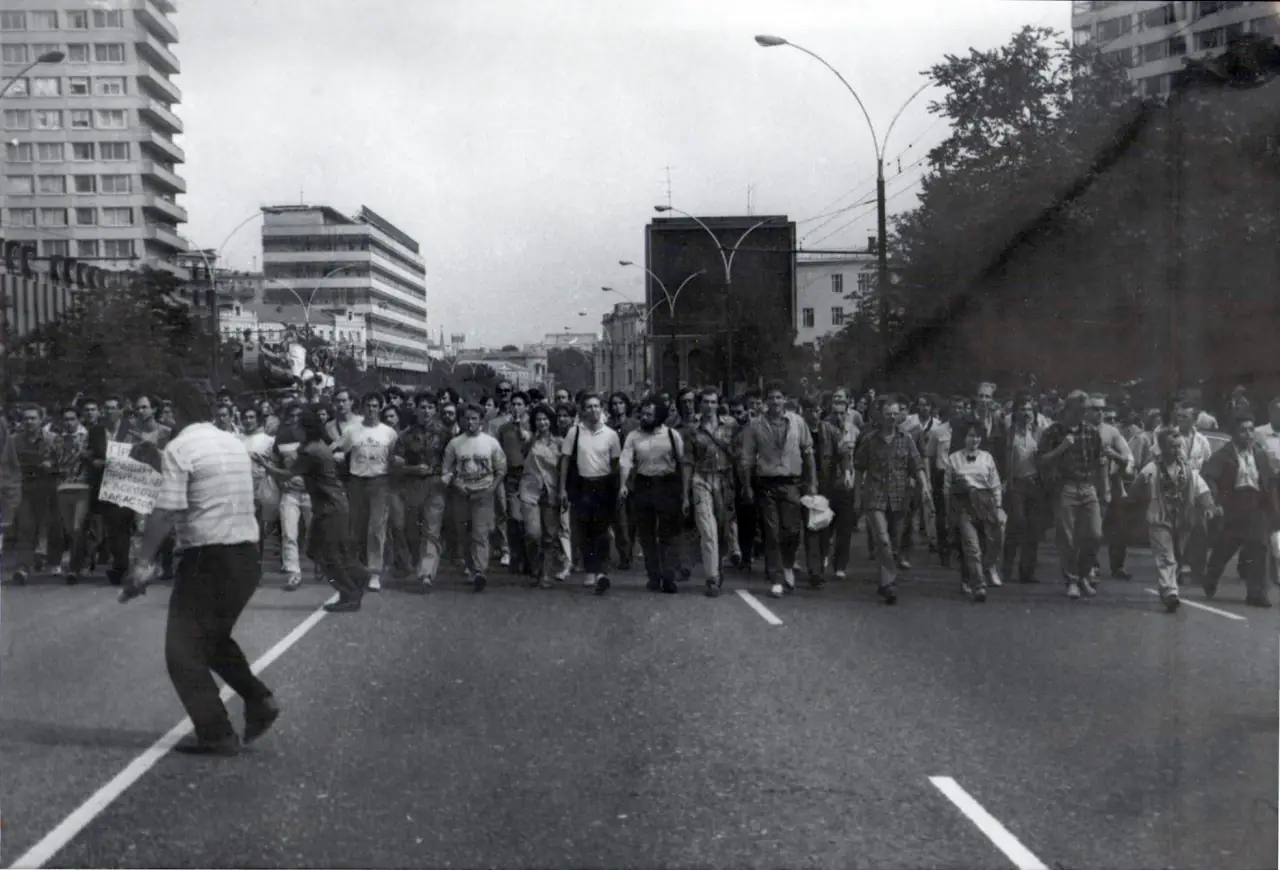
01 / CONTEXT & CONSEQUENCEBefore the event
The republican form and centralized Party rule long coexisted, and political opening made the old balance of power unworkable. The Party had concentrated personnel and resources across the republics; once its monopoly weakened, the constitutionally existing republican bodies could claim independent authority. Reform also brought old repression and national memory into public discussion. Economic difficulties and local mobilization influenced each other; sovereignty demands cannot be attributed only to a decline in living standards at the center or only to individual leaders' ambitions.
Failed economic coordination, resource competition, historical grievances, and conflicting democratic mandates coexisted, and Russia's sovereignty demands were especially important. The same tax sources and property could be claimed by both the union and the republics, and new elections let both sides claim to represent the people. The Russian Republic's pursuit of central institutions and resources was especially important. After glasnost exposed history, maintaining the union required new trust and rules; the old Party organizational command could not automatically replace these conditions for cooperation.
02 / CONTEXT & CONSEQUENCEHow change unfolded
Hardliners launched the August coup before the new union treaty was signed, and its failure pushed the republics to break away from the center faster. The hardliners claimed to be preserving the state but could not firmly control the capital and major institutions; the mobilization of coup opponents and the attitude of some armed forces together influenced the outcome. The coup's failure changed political prestige and available resources. It was an accelerator, not the starting point of all national and economic contradictions, and it must not obscure the sovereignty competition that had already advanced.
In March, referendums in some areas supported a reformed union, and Yeltsin was elected in June; the August coup failed, and in December the Ukrainian referendum, the Belovezha and Alma-Ata arrangements followed in succession, and Gorbachev resigned on the 25th. After August, declarations of independence by the republics and the transfer of assets from central institutions weakened Gorbachev's position. The December 1 Ukrainian referendum gave that country's leaders a clear mandate; on the 8th Russia, Ukraine, and Belarus signed the Belovezha Accords; on the 21st more republics joined the Alma-Ata arrangements. The resignation on the 25th was one link in this chain of changes.
03 / CONTEXT & CONSEQUENCEPeople, institutions and alternatives
The center tried to redefine the union, republic leaders sought power, and voters, demonstrators, and local organizations changed the negotiating space. Republic leaders did not act only according to the center's arrangements; voters, strikers, demonstrators, and national organizations also shaped the terms of negotiation. Gorbachev continued to seek a looser union, while the cooperation and competition of Yeltsin and others changed whether the center could act. Attributing responsibility entirely to one person erases the real decisions of other governments and local societies.
A loose union, a union of sovereign states, and independence were all once options; the December outcome cannot be used to infer what everyone intended in March. Efforts such as the new union treaty show that preserving some form of joint structure was not fantasy, but there was no stable consensus on the degree of support, ownership of resources, or the meaning of sovereignty. The votes in March and December took place in different political environments and cannot cancel each other out. We can compare the paths actually proposed and the obstacles they faced, but we cannot package a path that did not happen as a proven successful answer.
04 / CONTEXT & CONSEQUENCEAfter the turning point
Fifteen states became independent, and military, debt, border, and industrial-chain arrangements were reorganized; in some regions violent conflict continued or broke out. Former internal borders became international borders, many family and industrial ties were rearranged, and debt, nuclear weapons, and the attribution of troops required negotiation. National independence brought real autonomy, and also economic disorder and anxiety among minorities. The end of the Soviet Union was neither the endpoint nor the starting point of peaceful cooperation in all regions; several conflicts continued before and after.
Russia's principal international successor status does not mean it owns the history of the other republics; the shared experience was subsequently retold differently by different states. Later, each country commemorated independence or the loss of the union in different ways, and the experience of shared life did not thereby disappear. Russia's continuation of the principal international legal status does not mean other countries lack their own history and rights. Understanding this diversity of memory cannot directly infer from today's diplomatic conflicts what choice every family supported in 1991.
How the event unfolded
Political reform expanded
Open discussion and new institutions produced competing authorities.
Sovereignty contest
Struggles over law and resources weakened the center.
Coup and resistance
Failure changed the judgments of the public and elites.
Independence and agreements
Referendums and leaders' agreements closed most realistic paths back to the old union.
Facts supported by evidence
- The August coup failed to control the state and instead weakened the union and the party center.
- The December 1 Ukrainian referendum, December 8 Belovezha, December 21 Alma-Ata, and December 25 resignation followed in succession.
Major historical interpretations
- Structural crisis created risks; the specific choices of leaders and voters determined part of the outcome.
Questions still discussed
- Whether different reforms could have avoided disintegration is difficult to prove with a single counterfactual; the will of the republics must be specified by time, wording, and scope of participation.
Mikhail Gorbachev
General Secretary of the CPSU Central Committee, President of the Soviet UnionSought to save socialism through reform and helped end the Cold War, expanded political participation, and was unable to control economic and republican power struggles.
Boris Yeltsin
President of the Russian Republic and the Russian FederationOpposed the coup in 1991 and strengthened republican power, later promoted market transition; the forcible resolution of the constitutional conflict and the Chechen war constitute major issues.
References and evidence
These materials support this page's account. Check the purpose, perspective and accessible scope of each source. Notes identify the evidential limits of excerpts, summaries and timelines.
- The end of the Soviet UnionSeventeen Moments in Soviet History, a university history-source teaching project · Academic research
Read the feature and check the coup, the Ukrainian referendum, Belovezha, and the resignation; retain the different political paths.
- Reform and glasnostSeventeen Moments in Soviet History, a university history-source teaching project · Academic research
Read the feature and check how economic management reform expanded into political openness.
- Revealing the Russian Archives: Inside the Soviet UnionLibrary of Congress exhibition in cooperation with Russian archives · Archive
Provides documents and translations on grain requisition, repression, censorship, deportation, and reform; the 1992 general introduction's period stance must be read against other research.