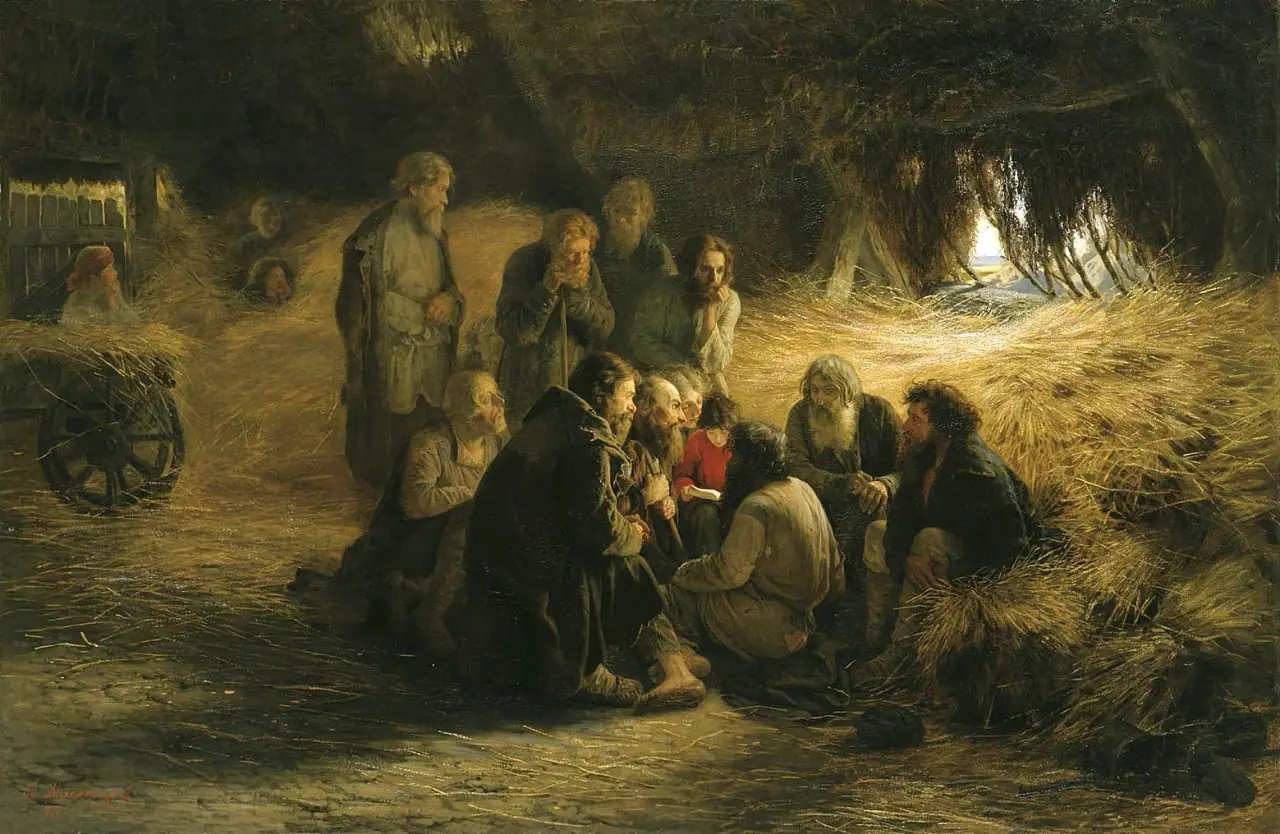
01 / CONTEXT & CONSEQUENCEBefore the event
Serfdom provided labor and tax revenue, while also restricting movement and provoking resistance; the question of emancipation had been discussed for many years. Village communes, the state, and landlords all drew resources from agricultural labor, while population movement and resistance made the old system increasingly difficult to stabilize. Emancipation involved compensation, land, and those responsible, and any reform would rearrange interests. Existing discussions and local practices provided options, so 1861 cannot be written as a sudden moral awakening completed by one person.
State competition, rural conflict, landlord interests, and bureaucratic improvement worked together and cannot be explained solely by moral awakening or a single economic indicator. Status restrictions hindered movement and the new military system, while the state was unwilling to lose tax revenue and landlords were unwilling to lose income. Village communes could maintain responsibility and security while also possibly restricting individual disposal. The difficulty of reform lay in these goals constraining one another; it was not that discovering a technical solution could eliminate all political and economic conflicts of interest.
02 / CONTEXT & CONSEQUENCEHow change unfolded
Defeat in the Crimean War exposed the state's weaknesses, and Alexander II publicly pushed forward preparations for reform. The new monarch put institutional change on the agenda, and local committees and central agencies gradually drafted rules. The war increased urgency but did not directly determine the size of allotments or the method of redemption. Only by distinguishing external competitive pressure, the ruler's decisions, and the specific negotiations over the law can one explain why the reform took a compromise form rather than a single liberalizing one.
Central and local committees drafted plans, the law was promulgated in 1861, and implementation followed through allotment division, redemption, and status transition, along with judicial, military, and other reforms. The law concerned status, landed property, transitional obligations, and implementation arrangements; March 3 in the Gregorian calendar corresponds to February 19 in the old calendar and must not be treated as two emancipations. Local implementation required verifying allotments and payments, and different regions were not synchronized. The judicial and self-government reforms of 1864 and the military service reform of 1874 were part of the accompanying transformation, and no single date can summarize their entire implementation.
03 / CONTEXT & CONSEQUENCEPeople, institutions and alternatives
Monarch and bureaucrats set boundaries, landlords participated in negotiations, and peasants influenced implementation through petitions, protests, and practical action. Landlords dominated many local plans, and bureaucrats also disputed scope and administrative authority; peasants influenced implementation through petitions, refusals, and local negotiations. Liberal professional groups later took part in schools, medical care, and legal work. Writing these actors into the account prevents the institutional change affecting tens of millions of people from being depicted only as a scene of the emperor signing.
There were contemporary proposals for the size of allotments, the terms of redemption, and the scope of self-government; retaining serfdom also carried military and political costs. One can discuss whether to grant more land, who should compensate, and how much authority self-governing bodies should have, but every proposal had fiscal and political thresholds for support. The peasants' understanding of land justice was also not entirely equivalent to the state's property classifications. Alternative paths must be based on measures actually discussed at the time, and cannot be assumed necessarily feasible by reasoning backward from later ideal outcomes.
04 / CONTEXT & CONSEQUENCEAfter the turning point
Personal dependence was abolished, but land compensation created new burdens, and labor mobility and state governance changed over the long term. Peasant households gained legal personality and new opportunities for activity, yet also had to pay and maintain communal responsibilities; some families supplemented income through seasonal work in cities and by-employment. Landowners and the state likewise faced changes in revenue and methods of management. Freedom, poverty, and mobility did not always move in step, and one cannot assert that every household's life improved equally merely by counting the number of people emancipated.
Markets and public life expanded, while unresolved land and political-rights questions fed into later revolutions. Self-government, courts, and professional public spheres changed the ways later claims to rights were made, and unresolved land and political-representation questions continued to ferment. The tightening of control after 1881 did not erase all the earlier reforms. Evaluation should look separately at legal status, resources, public services, and participation, and avoid using a single word, success or failure, to cover every dimension.
How the event unfolded
The reform agenda after the war
The monarch promoted preparations for emancipation.
The emancipation law
The law redefined relations between landowners and peasants.
Supporting institutions
The new status required judicial and local-governance reform.
Reform of military obligations
The Great Reforms went beyond a single land decree.
Facts supported by evidence
- The emancipation law was promulgated on February 19, 1861 in the old calendar, that is, March 3 in the Gregorian calendar.
- Status, land, and redemption were redefined, and judicial and local self-government reforms were advanced in 1864.
Major historical interpretations
- The reforms were a negotiated transformation to preserve the state's competitiveness, and also the result of peasants' long-standing demands.
Questions still discussed
- The impact of land arrangements on poverty and growth must be analyzed region by region; legal freedom and economic autonomy are not the same indicator.
Alexander II
Russian emperor; ruler of the era of the Great ReformsSupported emancipation and judicial and military reform; fundamental limits remained on land and political representation, and after his assassination constitutional government was not realized.
References and evidence
These materials support this page's account. Check the purpose, perspective and accessible scope of each source. Notes identify the evidential limits of excerpts, summaries and timelines.
- Russian imperial legal documents: emancipation of the serfsYale Law School,Lillian Goldman Law Library · Archive
Read the exhibition notes and check a set of legal and reform background items for the 19th day of the 2nd month of the old calendar in 1861.
- Thomas Pearson: State and Rural Self-Government, 1861–1875Cambridge University Press · Academic research
The public abstract discusses administrative reform, bureaucratic conflict, and implementation; no paywalled body page numbers were used.
- The Cambridge History of Russia, Volume 2: public abstracts on the imperial periodCambridge University Press · Academic research
Checked governance, estates, women, agriculture, economy, and thought in the public abstracts; this is not a page-by-page review of the whole book.
- The Cambridge History of Russia, Volume 2: public chronologyCambridge University Press · Academic research
Publisher's public PDF, used to check dates and chapter structure; the map insert does not thereby become openly licensed.
- Russia: A Country Study: body text on the nineteenth-century transformationLibrary of Congress, Federal Research Division; CountryStudies.us text mirror · Specialist reference
Actually read the main text on the Great Reforms, local governance, the judiciary, military service, and counter-reforms; cross-checked against the Yale law exhibition and academic chronologies; did not use unreviewed statistics or erroneous dates from older books.