01 / CONTEXT & CONSEQUENCEBefore the event
Persian power had already expanded into Media, Lydia and other regions, and Babylon possessed significant agricultural, urban, religious and scribal resources. The relationship between Nabonidus's rule and local religious institutions requires study, and hostile propaganda would also exaggerate conflict. One cannot assert, solely on the basis of panegyric texts about the new king, that the old ruler had lost all support among residents, or that the entire city held only one political attitude before the conquest.
Imperial expansion required agriculture, taxation, transport and political partners capable of coordinating localities, and Babylon possessed both wealth and religious prestige. The conquerors had to convert force into sustained supply, and local elites also had to judge how to maintain their own institutions. Cooperation does not erase inequality, nor is resistance necessarily only military in form; these relationships explain better than an assumption that the strong naturally swallow the weak how the takeover was sustained.
02 / CONTEXT & CONSEQUENCEHow change unfolded
The Persian army entered Babylon's domain; military victory deprived the old dynasty of its capacity for defense and coordination, and the city's center was subsequently taken over. Battle, entry into the city and royal ritual were distinct phases, and a narrative of bloodless takeover of the city cannot be extended to declare the entire campaign entirely free of violence. The sources help confirm the turning point, yet make it difficult to reconstruct household by household what residents actually did during those days.
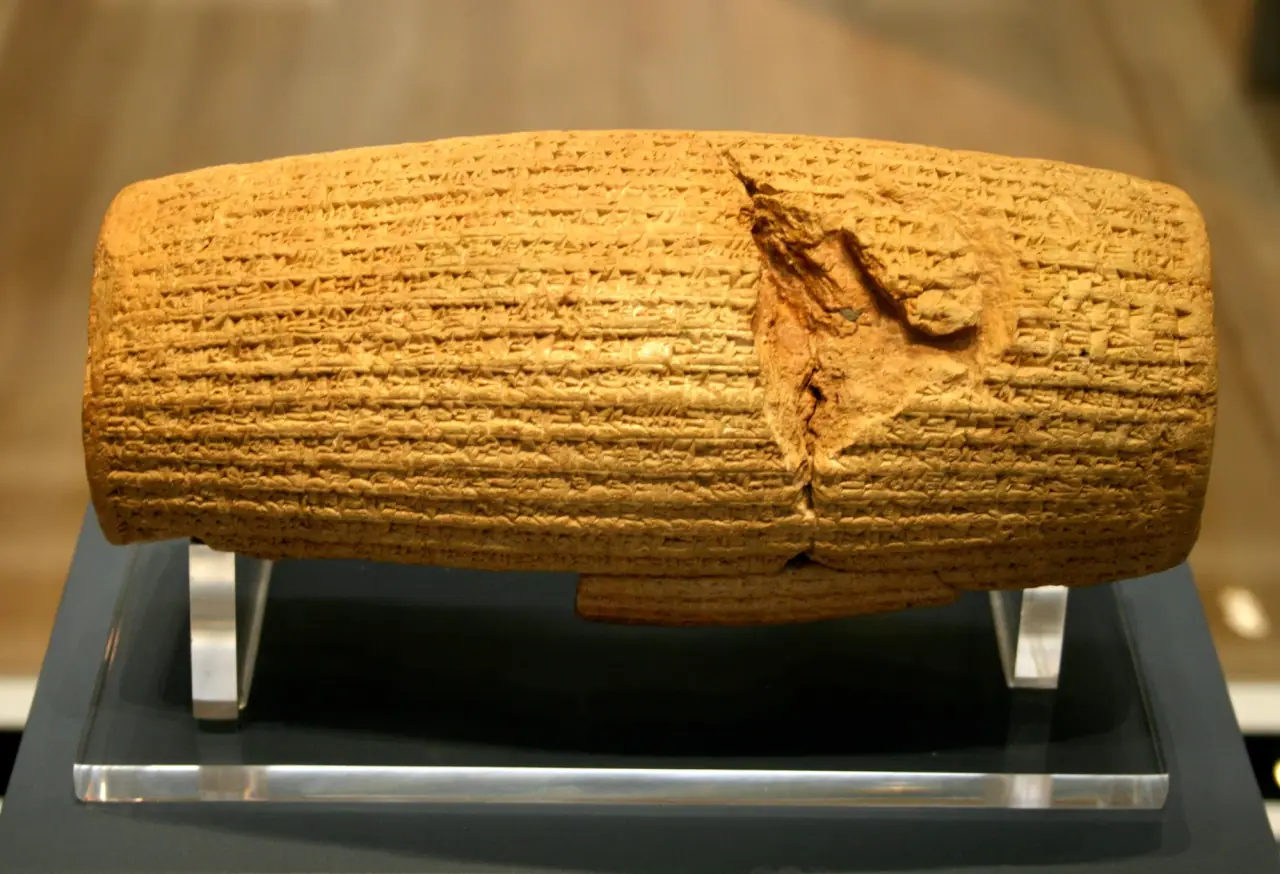
Military action destroyed the old dynasty's supports of rule; Persian power acquired the city and kingship, and the new king then expressed legitimacy through local ritual and writing. The cylinder's account of restoring divine statues, sacrifices and buildings belongs to a carefully chosen public language of the ruler. Scribal and fiscal institutions show continuity, while new military-political relations also changed the allocation of resources, so it can be described neither as a sudden reset of the whole society nor as a peaceful inheritance without change.
03 / CONTEXT & CONSEQUENCEPeople, institutions and alternatives
Cyrus and the army made military and political decisions, while Babylonian scribes, temples and local elites participated in expressing and operating the new kingship. The conquered were not limited to a single response of obedience, yet surviving sources preserve few self-accounts of ordinary households. One cannot automatically assume that a text written in a local language expresses the sentiments of all residents, nor erase the actual role of local personnel in the continuity of governance.
The old dynasty, local elites and residents could attempt resistance, cooperation, shifting allegiance or preservation of their own resources, with the concrete space varying by location and status. Military defeat narrowed choices, but does not prove that every earlier decision necessarily led to the same outcome. The sources are insufficient to quantify support among groups, and cannot verify the counterfactual judgment that a different religious or military course would certainly have preserved the old dynasty over the long term.
04 / CONTEXT & CONSEQUENCEAfter the turning point
Babylon became an important Achaemenid center; existing scribal, economic and religious institutions continued to operate under the new dynasty, and local resources also entered the larger imperial system of extraction and transport. The continuity of certain institutions does not mean all residents benefited, nor can the violence and burdens of dynastic change be automatically offset by promises to restore sacrifices. The outcome must be assessed by looking at political domination and concrete social relations together.
The Cyrus Cylinder was later invested with various symbolic meanings, including national identity, tolerance and rights, and these interpretations reflect the needs of different eras. The ancient document itself remains material for understanding Babylonian kingship and imperial takeover. Explaining separately the object's original genre, its later transmission and modern commemoration preserves its importance while avoiding the use of today's value vocabulary to draw conclusions about the experience of all people in antiquity.
How the event unfolded
The Battle of Opis
The third column of the chronicle records fighting at Opis and plunder and killing, and then records entry into Babylon without battle. Experiences at different locations cannot substitute for one another, and the transmission layers of the surviving later copies must also be stated.
The takeover of Babylon
The army entered the city, Nabonidus was captured, Cyrus subsequently entered, and appointments of officials and arrangements for sacrifices formed part of the takeover. The text's claim of entry into the city without battle cannot be expanded to mean the entire conquest was entirely free of violence.
The new king's royal texts
After the conquest, the cylinder explains the new rule through Babylonian deities and traditions of kingship, and narrates restoration and construction. The node is anchored to the year of conquest; the document's panegyric cannot be equated with the self-account of all residents or with a modern code of rights.
Facts supported by evidence
- In 539 BCE, Cyrus's army ended the Neo-Babylonian dynasty's rule over Babylon.
- The cylinder uses Akkadian cuneiform and explains the new ruler's legitimacy through Babylonian deities and traditions of kingship.
- The cylinder's panegyric, sacrificial and building narratives belong to ancient royal documents and cannot be directly equated with a modern code of universal rights.
Major historical interpretations
- Adopting local religious and scribal language helps explain how the new dynasty sought institutional cooperation and organized long-term rule.
- Continuity of administrative and religious institutions and new military domination can exist simultaneously and are not mutually exclusive.
Questions still discussed
- Local elite cooperation, residents' responses and the degree of violence in the campaign require corroboration from multiple kinds of sources; a single panegyric document is insufficient to characterize an entire society.
- The cylinder's modern symbolism of rights and its ancient meaning should be studied separately; later prestige cannot be used to infer original intent.
Cyrus II
Founder of the Achaemenid EmpireHe expanded his rule through conquest and cooperation with local elites. The Cyrus Cylinder explains the new king's legitimacy in local theology, which can show royal policy and propaganda, but also has its silences and limitations.
References and evidence
These materials support this page's account. Check the purpose, perspective and accessible scope of each source. Notes identify the evidential limits of excerpts, summaries and timelines.
- The Achaemenid Persian Empire (550–330 B.C.)The Metropolitan Museum of Art · Museum research
Empire formation, provinces, and court art.
- The Cyrus cylinder: image 262895001The British Museum · Museum research
The collection description allows verification of content; the image is CC BY-NC-SA, and this does not authorize reuse of images in this project.
- Persepolis Fortification TabletsUniversity of Chicago ISAC / Richard T. Hallock · Academic research
Publication introduction to Elamite administrative tablets; the grain payment records have regional limitations.
- Iran: A Country Study, fifth edition (2008)Library of Congress, Federal Research Division; Glenn E. Curtis and Eric Hooglund, eds. · Academic research
The official LOC full-text OCR was obtained, and body paragraphs on history, women, education, and government politics were read; this was not merely reading the table of contents or a summary, nor is any claim made of having read all 416 scans. The study has limitations of period and national-studies framework; errors in the history chapter such as Chaldiran 1524 and Gulistan 1812 are not carried over, and 1514 and 1813 are adopted respectively per specialized research; the internal discrepancy in the history and education chapters over Tehran University 1935/1934 is likewise not copied directly.
- Nabonidus Chronicle, British Museum number 35382British Museum · Museum research
The original museum's complete object fields were actually checked: the extant tablet is tentatively dated to the 3rd–2nd century BCE, while the events it records are in the 6th century BCE; the object, the narrative era, and modern photography are distinguished. This catalog field differs from the approximately 529 BC label on the Livius photo page; the production dating follows the original museum, and no open license for the museum's photography is inferred from the ancient object.
- ABC 7: Nabonidus Chronicle, translation and commentaryLivius; translation attributed to A. K. Grayson with later research adjustments · Primary source
The relevant columns of the translation and the notes on lacunae have been read; the third column distinguishes the battle/killing at Opis, the entry into Babylon without battle, and Cyrus's later entry into the city, while the lacuna in the place name for 547 in the second column is not forced to mean Lydia. Translation and later commentary are kept in separate layers; the object's production date is listed separately per the BM original museum's tentative 3rd–2nd century BCE.