01 / CONTEXT & CONSEQUENCEBefore the event
The tobacco boycott, newspapers, translation, and cross-border contacts had already provided a language of reform, while court loans, prices, and the punishment of officials accumulated discontent. Different participants did not necessarily understand the institution of justice in the same way, yet they could form a temporary alliance around limiting arbitrary rule. Petitions, sanctuary, and market closures made everyday organization a political resource; the constitutional movement cannot be explained entirely as a direct copy after the introduction of some particular European idea.
Royal finances depended on intermediaries, loans, and concessions, while local powers and foreign forces limited independent collection. Merchants, clerics, and the educated therefore sought to control arbitrary expenditure and decisions through law, though their interests differed. Institutional reform had to arrange both resources and legitimacy and could not rely only on writing rights into texts; nor can it be assumed that all those opposed to foreign pressure agreed on the same social and religious order.
02 / CONTEXT & CONSEQUENCEHow change unfolded
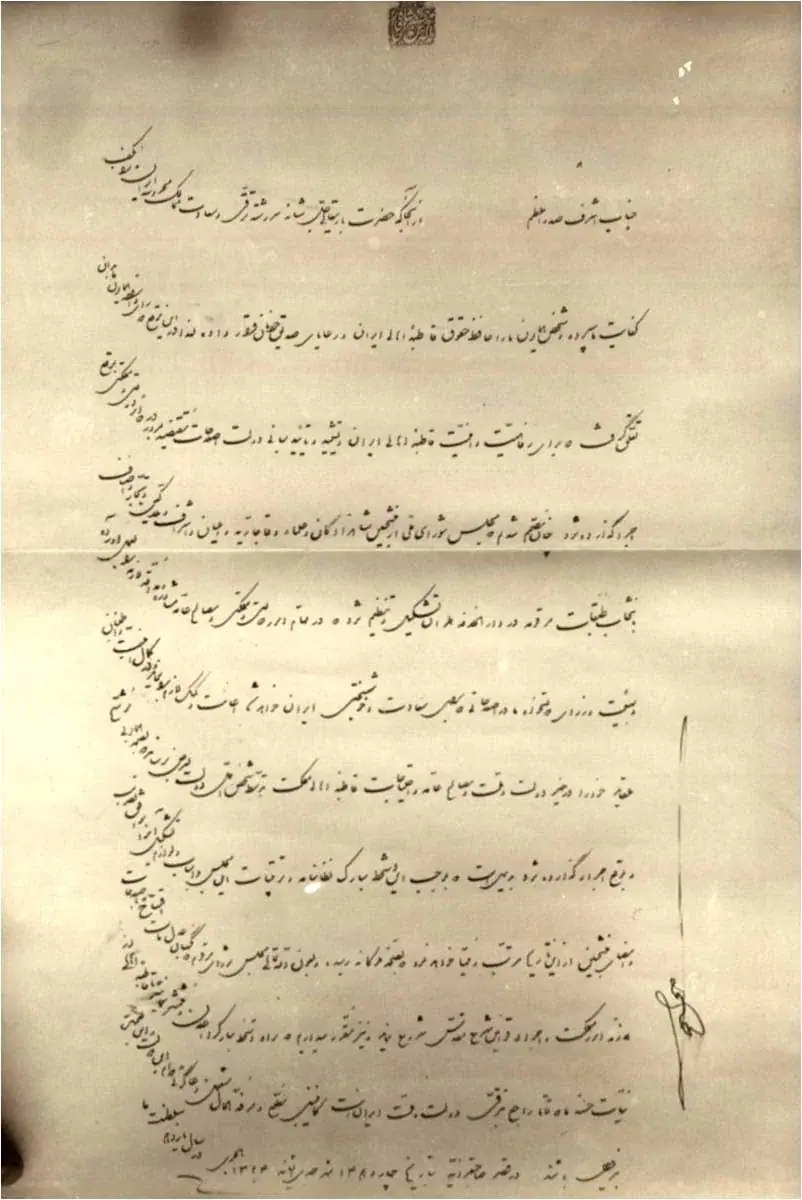
The punishments, protests, and sanctuary petitions of 1905 to 1906 put the crown under sustained pressure, and a commitment to establish a parliament gradually took shape. The convening of the parliament and the signing of the Fundamental Law in 1906 showed that public demands were beginning to be translated into legal arrangements. Specific conflicts explain the timing of mobilization, while financial difficulties and the long-term spread of reform explain why it went beyond a local grievance; the two layers of causes cannot simply be substituted for each other.
The parliament and the 1907 Supplementary Law established rules; the crown bombarded the parliament by force in 1908, and the opposition turned to local resistance. In 1909 the constitutionalists entered Tehran and deposed the shah, but the restored institutions remained constrained by finances and Russian-British pressure. The 1911 ultimatum and the closure of the parliament again interrupted the process; the revolution therefore involved repeated back-and-forth among law, military force, and local organization, and cannot be written only as a parliamentary history of legislators.
03 / CONTEXT & CONSEQUENCEPeople, institutions and alternatives
Merchants and religious networks provided funds and organization, while intellectuals, journalists, local councils, and armed forces influenced the plans and their implementation. Women participated through schools, writing, fundraising, and other actions but did not obtain equal voting eligibility. Different linguistic and local communities also had their own demands, and capital elites could not automatically speak for them; cooperation in opposing the crown did not mean agreement on every element of the future system.
There was room for compromise between the monarch and the constitutionalists, and within the movement different paces of reform, financial partners, and armed routes could be chosen. Each path was constrained by military power, tax sources, and international pressure, and it cannot be proven that a change of leader alone would necessarily have brought success. Discussing possibilities should specify who controlled which resources at the time, and should not use the eventual failure to argue retrospectively that residents' petitions, legislation, or local resistance were never meaningful.
04 / CONTEXT & CONSEQUENCEAfter the turning point
The constitution, parliament, and new public organizations really existed, but financial oversight and political rights were not stably implemented. Fighting, sieges, and disrupted trade imposed costs on residents, and foreign intervention further compressed the institutional experiment. Formal political status still involved exclusion, and women's participation did not equal electoral equality; institutions, social mobilization, and family life should be assessed separately, and a single label of success or failure cannot replace all the outcomes.
The rule of law, parliament, and civil rights became a political language repeatedly used by later generations, and schooling, newspapers, and associations accumulated beyond the moment the parliament was closed. Different regimes would selectively invoke the constitutional heritage, and the meaning of rights changed accordingly. Comparing texts with implementation, the capital with the provinces, and those who gained rights with those excluded can preserve the revolution's concrete creations without turning it into an inevitable prelude to later centralization.
How the event unfolded
Protests converge
Prices, the punishment of merchants, and grievances over justice gradually brought petitions together, and the market and religious networks provided organization. The participants did not all initially share the same modern constitutional program.
The parliament is established
A parliament convened and drafted a basic law, turning public demands into rules that could be debated. Laws, budgets, and actual military power played different roles, and eligibility restrictions still excluded many residents.
Royal Backlash
The monarchy bombarded the parliament with military force, and local resistance spread in response. The constitutional cause's legal standing could not by itself withstand the army and foreign support, and residents also bore the risks of disrupted trade and siege.
Constitutional Restoration
Local constitutional forces entered Tehran and deposed the shah; the constitutional restoration remained constrained by finances, factions, and foreign pressure. A military victory did not mean social participation had become equal.
Setback Again
A Russian ultimatum and domestic armed pressure led to the parliament being closed again, and financial reform and sovereignty were restricted. Yet the experience of public organizations and women's schooling did not all vanish on the same day.
Facts supported by evidence
- The parliament convened and the Fundamental Law was signed in 1906, and the 1907 Supplementary Law further provided for rights, the separation of powers, and religious-law oversight.
- The crown bombarded the parliament in 1908; in 1909 the constitutional forces returned to Tehran and deposed Mohammad Ali Shah.
- The Russian ultimatum and domestic armed pressure in 1911 led to the parliament being closed again; women's participation in the movement did not mean obtaining the right to vote.
Major historical interpretations
- Financial autonomy, legal oversight, and opposition to arbitrary power connected different groups, but the alliance required constant negotiation and cannot be regarded as a homogeneous camp.
- The role of local councils, newspapers, and women's organizations made the revolution's influence exceed the single measure of whether a constitution remained effective.
Questions still discussed
- How much weight religion, national sovereignty, and social reform each carried should be analyzed separately by region, participant, and phase.
- How foreign intervention combined with domestic resources and factional conflict to constrain the constitutional order cannot be explained by only one factor for all the setbacks.
Women educators and writers of the constitutional period
A group that expanded public action beyond formal electoral exclusionThrough schools, articles, associations, fundraising, and support, they participated in politics and education, acting beyond the boundary of whether the law recognized their electoral eligibility. Members came from different families and intellectual backgrounds and were not a single unified women's camp. The better-preserved urban records also cannot represent rural areas and all classes; participation against royal power does not mean they all held the same positions on religion, family, or economic policy.
References and evidence
These materials support this page's account. Check the purpose, perspective and accessible scope of each source. Notes identify the evidential limits of excerpts, summaries and timelines.
- CONSTITUTIONAL REVOLUTION i. Intellectual backgroundEncyclopaedia Iranica · Academic research
Political thought and factional divisions in 1905–1911.
- CONSTITUTIONAL REVOLUTION iii. The ConstitutionEncyclopaedia Iranica · Academic research
The 1906 constitution, the 1907 supplementary law, and later amendments.
- FEMINIST MOVEMENTS i. INTRODUCTION, ii. IN THE LATE QAJAR PERIODEncyclopaedia Iranica / Janet Afary · Academic research
Women's participation, education, and political exclusion.
- Iran: A Country Study, fifth edition (2008)Library of Congress, Federal Research Division; Glenn E. Curtis and Eric Hooglund, eds. · Academic research
The official LOC full-text OCR was obtained, and body paragraphs on history, women, education, and government politics were read; this was not merely reading the table of contents or a summary, nor is any claim made of having read all 416 scans. The study has limitations of period and national-studies framework; errors in the history chapter such as Chaldiran 1524 and Gulistan 1812 are not carried over, and 1514 and 1813 are adopted respectively per specialized research; the internal discrepancy in the history and education chapters over Tehran University 1935/1934 is likewise not copied directly.