01 / CONTEXT & CONSEQUENCEBefore the event
Royal centralization, repression by security agencies, and uneven development restricted political expression, while urbanization, education, and cultural change expanded expectations. Religious, bazaar, university, and professional networks allowed criticism to spread, and Khomeini in exile became a powerful symbol. The background was not a single variable, and participants also changed their demands as events unfolded; the later revolutionary language cannot be placed unchanged into everyone's initial grievances.
The state depended on oil revenue and centralized decision-making, the gap between political accountability and social expectations widened, and developmental changes created new professions and organizations. Religious networks provided channels for communication and assembly, workers could affect production, and intellectuals and students raised demands for rights. These resources could support one another and also contained inconsistent goals; economic, cultural, and international-relations explanations cannot be simplified into a choice of only one of them.
02 / CONTEXT & CONSEQUENCEHow change unfolded
The 1978 article attacking Khomeini, along with the protests, deaths, and mourning in Qom, escalated mobilization, and subsequently different cities and social organizations joined. Alternating repression and concession did not restore trust, and strikes affected state revenue and daily operations. The specific trigger helps explain timing, but it must still be combined with long-term organizational and social conditions; a single newspaper dispute cannot be treated as a cause sufficient on its own to overthrow the entire dynasty.
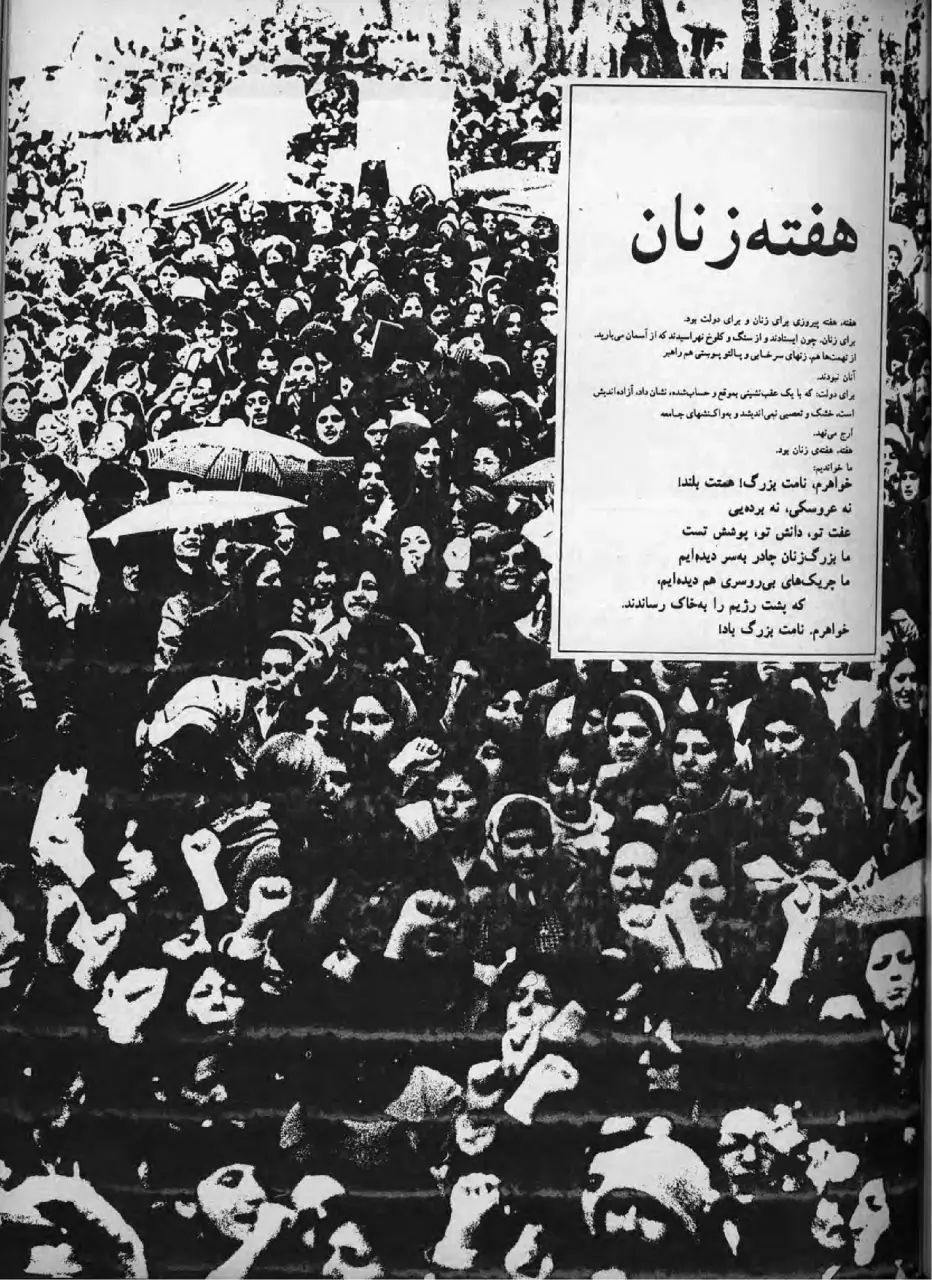
The Shah left the country in January 1979, Khomeini returned in February, and military neutrality and armed conflict ended the monarchical government. After the Bazargan provisional government was formed, the referendum, associations, local conflicts, and press competition continued to shape institutions, and the March women's protests signaled disagreements over rights. In November the hostage crisis prompted the provisional government's resignation, and at year's end the constitution established a new power arrangement; seizing power and deciding institutions were connected but distinct stages.
03 / CONTEXT & CONSEQUENCEPeople, institutions and alternatives
Khomeini and his organization gained important advantages, while workers, clerics, liberals, the left, women, students, and local communities still acted on their own. Strikes and family support made the revolution exceed the leader's speeches, and differences in armed and organizational resources affected who could leave institutional results behind. Not all clerics, all women, or all minority groups can be written as homogeneous camps, and the recollections of the victors are not sufficient to replace other participants.
Constitutional monarchy, a provisional government, different republic designs, and various religious-political proposals existed at the same time, but their resources and levels of support were unequal. When discussing unrealized options, it is necessary to distinguish public claims, executable organizations, and the force that could actually be controlled. The final system's victory does not prove that all alternatives were always false, nor can it be asserted in reverse that if only some leader had been more moderate, later conflicts could necessarily have been avoided.
04 / CONTEXT & CONSEQUENCEAfter the turning point
The republic was established and state institutions were reorganized, but political and gender rights did not change in the same direction. Nationalization, property transfers, newspaper closures, and local conflicts rearranged social relations, and the hostage crisis profoundly changed US-Iran relations. The revolution both expanded mobilization and public participation for some groups and excluded other organizations; any assessment must specify who gained or lost what, and at which stage.
The combination of guardianship of the jurist, elections, and revolutionary institutions shaped the later republic, and revolutionary memory also became a resource for different political demands. The experiences of women, workers, and local movements remind us that opposition to the monarchy did not automatically equal support for every subsequent policy. Commemorative images often focus on leaders and cheering crowds; only by comparing the newspapers, laws, and protest materials of the time can the disagreements omitted by celebration be seen.
How the event unfolded
Nationwide mobilization expands
Demonstrations, mourning, and strikes converged through religious, bazaar, university, and labor networks, affecting state finances and operations. Common opposition to the monarchy did not mean that all parties had already agreed on all future institutions.
The monarchical government collapses
The Shah left in January, Khomeini returned in February, and military neutrality and armed conflict ended the monarchical government. The departure, the end of the government, and the establishment of the new constitution are several distinct political moments.
March women's rights protests
International Women's Day and the protests of the following days showed that dress, public space, and rights were still contested. Participating in the anti-Shah movement did not mean agreeing with all arrangements of the new power, nor did it make all women hold the same position.
Competing republic proposals
The spring referendum supported the name of a republic, while the provisional government and revolutionary organizations still operated in parallel. The voting options, institutional powers, and demands of minority communities require independent analysis; the name cannot substitute for institutional debate.
Hostage crisis
In November the US embassy was seized, the provisional government resigned, and revolutionary internal and foreign relations were rearranged. Grievances over past US intervention cannot automatically justify holding diplomats captive.
New constitution established
The constitution referendum at year's end established a new power structure including guardianship of the jurist, and differences in social and organizational resources affected the outcome. The system's victory does not prove that all participants shared this blueprint from the beginning.
Facts supported by evidence
- The Shah left the country in January 1979, Khomeini returned in February, and the monarchical government ended in February amid armed conflict and military neutrality.
- The spring republic referendum, the March women's protests, the November embassy hostage crisis, and the constitution at year's end were successive and distinct political processes.
- The anti-Shah coalition included different religious, secular, class, and local organizations, and the new system cannot be regarded as the identical goal of all participants from the outset.
Major historical interpretations
- The combination of religious networks, strikes, and the state's decision-making crisis helps explain why mobilization could exceed elite petitions.
- After the revolution, unequal organizational and armed resources meant that broad participation did not translate into all parties equally sharing institutional power.
Questions still discussed
- The roles of economic imbalance, political exclusion, and religious and cultural change in the revolution should be analyzed using explicit mechanisms and stages.
- Between the dynasty's fall and the later institutional concentration there were choices and conflicts; the outcome cannot be used to infer backward that everything was predetermined.
Ruhollah Khomeini
Revolutionary leader and first Supreme Leader of the RepublicHe became the core of the anti-Shah movement through religious networks and political mobilization, and promoted the guardianship of the jurist. The relationship between his authority and the revolution's diverse participants needs to be understood beyond individual biography.
Mehdi Bazargan
Prime Minister of the 1979 interim governmentHe tried to organize the post-revolutionary state through administrative, legal, and governmental institutions, while facing the overlapping powers of Khomeini, the Revolutionary Committees, and the new armed organizations. The interim government resigned during the hostage crisis, showing that the anti-Shah coalition had not formed a single institutional program. His relatively moderate personal stance cannot by itself explain the outcome; it must be studied together with the resources, organization, and social support he could control.
References and evidence
These materials support this page's account. Check the purpose, perspective and accessible scope of each source. Notes identify the evidential limits of excerpts, summaries and timelines.
- IRAN ii. Islamic period (page 6)Encyclopaedia Iranica · Academic research
The Pahlavi era and the 1978–1979 upheaval; not to be used to infer the present.
- KHOMEINI i. LifeEncyclopaedia Iranica / Hamid Algar · Academic research
Biographies must be read against social, institutional, and diplomatic sources, and value judgments should not be adopted directly.
- HOSTAGE CRISISEncyclopaedia Iranica · Academic research
The 1979–1981 hostage crisis and the internal power struggle of the revolution.
- ECONOMY ix. IN THE PAHLAVI PERIODEncyclopaedia Iranica · Academic research
Land reform, industry, and oil revenue; used only for the period it covers.
- FEMINIST MOVEMENTS iii. IN THE PAHLAVI PERIODEncyclopaedia Iranica · Academic research
Women's organizations, the 1963 suffrage, and the tensions of state reform.
- ECONOMY x. UNDER THE ISLAMIC REPUBLICEncyclopaedia Iranica / Vahid F. Nowshirvani · Academic research
Mainly covers up to the early 1990s; the update date does not mean the content covers the present.
- Iran: A Country Study, fifth edition (2008)Library of Congress, Federal Research Division; Glenn E. Curtis and Eric Hooglund, eds. · Academic research
The official LOC full-text OCR was obtained, and body paragraphs on history, women, education, and government politics were read; this was not merely reading the table of contents or a summary, nor is any claim made of having read all 416 scans. The study has limitations of period and national-studies framework; errors in the history chapter such as Chaldiran 1524 and Gulistan 1812 are not carried over, and 1514 and 1813 are adopted respectively per specialized research; the internal discrepancy in the history and education chapters over Tehran University 1935/1934 is likewise not copied directly.