01 / CONTEXT & CONSEQUENCEBefore the event
Defeat brought fundamental challenges to militarism and the Meiji constitutional system; disarmament and democratization became Allied occupation objectives, and Japanese society also had prior experience of civil rights, labor, and women's rights movements. How the emperor system would be retained, where sovereignty should reside, and how social rights would be guaranteed did not have agreed answers from the outset. Ruins and material shortages meant institutional reconstruction and daily survival proceeded simultaneously.
The occupation authorities' ultimate authority, the Allies' demands to prevent renewed military expansion, and political considerations of preserving the emperor system together shaped the institutional framework. Domestic civil-society constitutional drafts, political parties, and women's movements put forward different views of sovereignty and social rights. External coercion and domestic demands proceeded in parallel; the provisions came both from negotiations under unequal power and were constrained by the continuity of the old system and practical governing capacity.
02 / CONTEXT & CONSEQUENCEHow change unfolded
The Japanese government's early proposals retained much of the old system and did not meet the occupation authorities' requirements; in February 1946 GHQ completed a draft and presented it to the Japanese side. After accepting the core principles, the Japanese government continued negotiations and rewrites, and the draft then went to the Privy Council and the Imperial Diet. Occupation pressure was a concrete turning point, but the whole process cannot be reduced to MacArthur single-handedly announcing a new constitution, nor misdated as drafting beginning only in 1947.
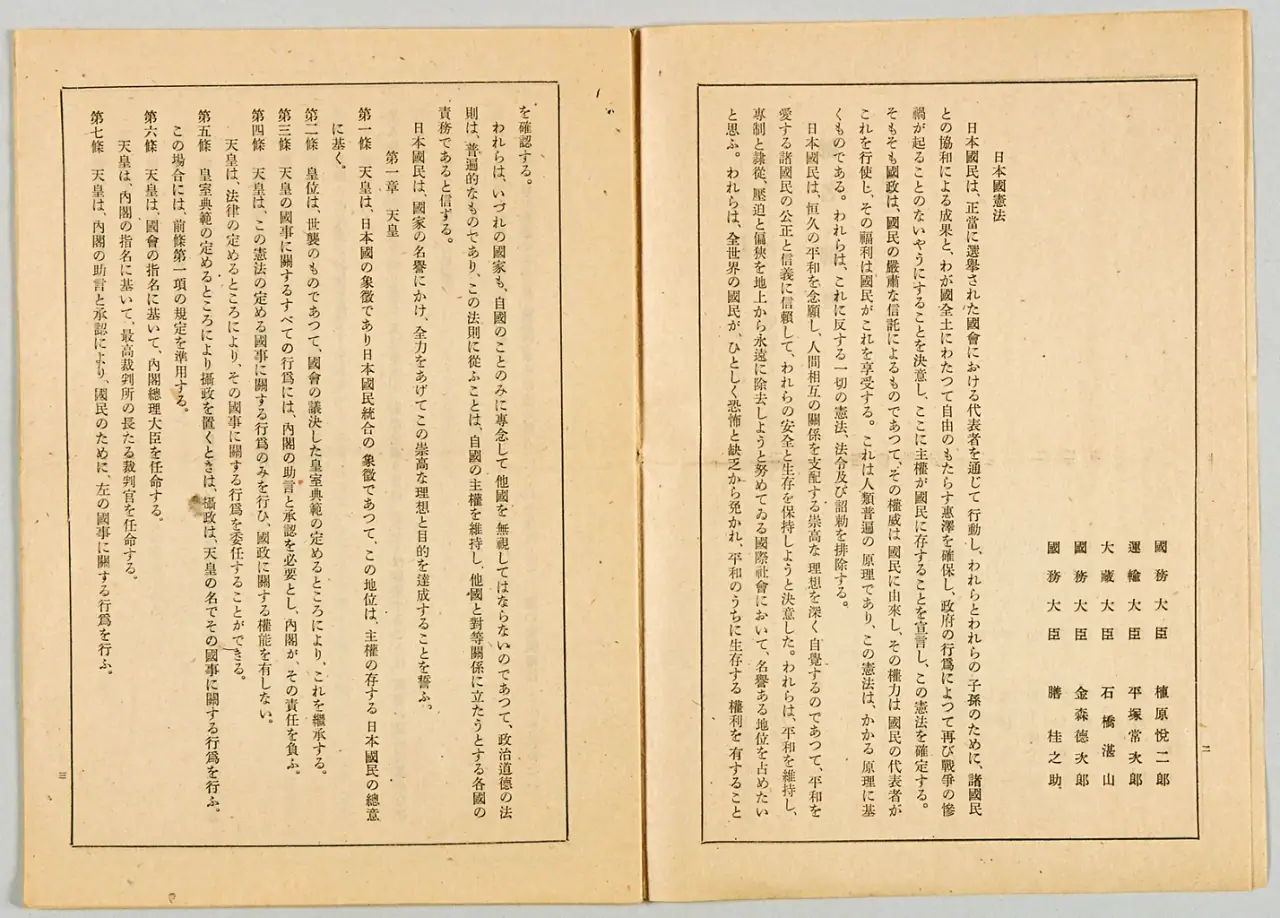
The February 1946 GHQ draft became the key basis; after the government announced the direction of constitutional revision, women participated in House of Representatives elections for the first time in April. From June the Imperial Diet deliberated, with committees and both houses amending some provisions, and the main votes were completed in October. The new constitution was promulgated on November 3 and took effect on May 3, 1947; the Diet, courts, local self-government, and civil law were adjusted accordingly, and the Popularization Association spread knowledge of rights.
03 / CONTEXT & CONSEQUENCEPeople, institutions and alternatives
Occupation officials determined the draft and the boundaries of approval, while the Japanese cabinet, legal scholars, legislators, and bureaucrats handled negotiations and legal alignment; their influence was not equal. Civil groups and women legislators raised claims to social and family rights, and residents also participated in the process of acceptance through elections and public discussion. Pamphlets brought constitutional language into households, but print runs cannot prove that all citizens understood or enjoyed their rights.
Conservative revisions of the Meiji Constitution, various civil-society democratic drafts, and proposals concerning the emperor, bicameralism, and social rights all appeared at the time. Their feasibility was constrained by occupation approval, government power, and the old-law amendment procedure; texts that were not adopted cannot be treated as paths that could necessarily have been realized. When comparing proposals, sovereignty and rights should be examined article by article, rather than merely labeling a draft as autonomous or foreign.
04 / CONTEXT & CONSEQUENCEAfter the turning point
Sovereignty shifted from the emperor to the people, the emperor became a symbol, basic rights, gender equality, and social security provisions gained a constitutional basis, and rules for the parliament, judiciary, and local self-government were rewritten. Article 9 renounces war and the maintenance of war potential, and subsequent security practice has produced interpretive disputes. Legal proclamation did not mean equality in life arrived immediately; women's labor, family care, and the status of former colonial subjects still require separate examination.
The new constitution became an important resource for postwar political participation, rights litigation, and pacifism, while post-occupation Japan-U.S. security arrangements kept the constitution and actual policy in long-term interaction. Acknowledging external leadership in its making need not deny later social acceptance and use; likewise, broad acceptance cannot retroactively erase the unequal power of the time. The history of its making, the meaning of its provisions, and policy debates in different periods require separate evidentiary treatment.
How the event unfolded
Defeat and the demand for constitutional revision
Allied occupation and democratic demands in Japanese society together brought the Meiji constitutional system under review, with no agreed solution on the emperor and sovereignty.
February: the GHQ draft
GHQ presented a draft to the Japanese side, and the Japanese government accepted the core principles under occupation power and continued negotiations.
April: women stand for election
The April 10 election brought women into the House of Representatives electoral process for the first time, changing parliamentary personnel and public demands.
June–October: parliamentary deliberation
Both houses and committees amended parts of the text, while the Allied Far Eastern Commission and GHQ continued to exert influence.
November 3: promulgation of the constitution
The government promulgated the new constitution; half a year remained before it took effect, and implementing legislation and popularization work continued.
May 3: implementation and popularization
The new constitution took effect; legal revisions and adjustments to the two houses and local institutions began bringing its provisions into governance and family life.
Constitutional practice after the occupation
The peace treaty and Japan-U.S. security relations changed the environment in which the system operated; the restoration of sovereignty did not end the debate between the peace clause and security policy.
Facts supported by evidence
- GHQ presented the key draft in February 1946; the core drafting process occurred in 1946, not 1947.
- Women first participated in House of Representatives elections on April 10, 1946, after which the Imperial Diet deliberated and amended the constitutional revision bill.
- The Constitution of Japan was promulgated on November 3, 1946, and took effect on May 3, 1947.
- The original constitutional text provides for popular sovereignty, the emperor's symbolic status, basic rights, and the war renunciation in Article 9, and required implementing legislation.
- The Constitution Popularization Association was established in late 1946 and in 1947 spread the constitution through pamphlets, lectures, and other means; propagated ideals cannot be directly equated with actual life.
Major historical interpretations
- The decisive role of external power and Japanese domestic participation can coexist; the draft's origins, deliberation and amendment, and social acceptance are three distinct levels of observation.
- The constitution changed the language of rights but also had to enter daily life through civil law, labor, education, and local institutions; legal promulgation cannot be treated as equality already achieved.
Questions still discussed
- The dichotomy of "imposed" versus "autonomously made" easily obscures specific texts and procedures; research should clarify what GHQ decided, what the Japanese parliament amended, and what society later formed through practice.
- The relationship between Article 9 and the postwar security system has long been debated; this topic presents the drafting history and original text, and does not package any contemporary policy position as the shared intent of all participants in 1946.
Women seeking political participation and social rights
Group members, voters, and women legislatorsWomen entered public life through education, organization, publishing, and movements; they were still excluded after the 1925 introduction of universal male suffrage and first took part in House of Representatives elections in 1946. Women legislators and civic groups took part in discussions of family and social rights, and the changes cannot be written entirely as gifts from the occupation authorities. Different classes and political positions were not uniform, and constitutional equality provisions did not immediately eliminate disparities in employment, family, and care.
Families in postwar reconstruction
Bearers of housing, food, repatriation, and rights practicePeople returning from battlefields and former colonies, widows, orphans, the injured and ill, and existing residents faced different resource and status problems. Finding food, repairing housing, and maintaining care occurred alongside elections, land, and labor reforms. The bright family depicted in constitutional pamphlets is an institutional vision and cannot be used to prove that scarcity had ended; unpaid labor within families is also real work on which reconstruction depended.
References and evidence
These materials support this page's account. Check the purpose, perspective and accessible scope of each source. Notes identify the evidential limits of excerpts, summaries and timelines.
- The birth of the Constitution of JapanNational Diet Library of Japan · Archive
Occupation, drafts, Diet deliberation, and implementation of the 1947 constitution; includes original documents and background explanations.
- The GHQ Draft and the Japanese Government's ResponseNational Diet Library of Japan · Archive
Actually read the full text of Part Three; the February 1946 GHQ draft, the government's rewriting, and the Far Eastern Commission debates. One page states March 17 while another states April 17; the main text does not rely on that disputed date.
- The 1946 Imperial Diet deliberation of the new constitutionNational Diet Library of Japan · Archive
Actually read the entire feature text and check the April 10, 1946 women's suffrage and candidacy, the June–October deliberations, and the November 3 promulgation, distinguishing the GHQ-led draft, parliamentary revisions, and pressure from the Far Eastern Commission.
- Implementation of the 1947 Constitution and public education activitiesNational Diet Library of Japan · Archive
Actually read the entire text; it took effect on May 3, 1947, with corresponding legal revisions, elections to both houses, and a constitution popularization association. The popularization pamphlets are propaganda materials and cannot prove that rights were immediately realized.
- English Translation of the Original Text of the Constitution of JapanNational Diet Library of Japan · Primary source
Actually read the provisions on the preamble, the emperor, Article 9, fundamental rights, education and labor, and local autonomy; the November 3, 1946 promulgation and May 3, 1947 coming into force are listed separately.
- The Formation of Fundamental Human Rights Guarantees: Drafts and DeliberationNational Diet Library of Japan · Archive
Actually read the sections on human rights, social rights, and foreigners' rights; civil groups, political parties, and government drafts all participated; constitutional text and implementation conditions are kept separate.
- The new constitution, a bright life (1947)Library of Congress · Primary source
1947 booklet popularizing the constitution for households; the promotional text expresses institutional ideals and does not directly prove implementation effects. The online title search and holdings have been checked; full-text automated capture was unsuccessful, and page-by-page reading is still pending.
- Occupied and Rebuilt Japan, 1945–1952Office of the Historian, U.S. Department of State · Specialist reference
Land reform, democratization, the Cold War turn, and the peace treaty; a retrospective account by a US institution.
- Rovell's memorandum reviewing a private draft constitutionNational Diet Library of Japan / U.S. National Archives RG331 · Primary source
Read the complete document description and the image of the fourth page original, and check the January 11, 1946 submission to the Chief of Staff, the Constitutional Research Association proposal, and GHQ/SCAP GS(B)02090–02092. Do not claim to have read the entire memorandum or treat it as the final constitution.
- Japan: A Country Study (1992 edition), Historical Background chapterFederal Research Division, Library of Congress; edited by Ronald E. Dolan and Robert L. Worden · Specialist reference
Actually read the relevant passages of the 1992 edition's historical chapter: PDF pages 49–62, 64–80, and 81–110, and sampled the social environment section on PDF pages 129–132; the research mainly runs through 1990. The book's old Yayoi dating, some ethnic classifications, and several dates are clearly outdated or erroneous; errors such as the atomic bomb in 1941/August 8 and Kwantung Army losses of 80,000 were not adopted; precise dates and causation were checked against updated archaeology, NDL, and institutional materials. Makes no claim to have read all 670 pages or to treat old statistics as 2024 current conditions.