01 / CONTEXT & CONSEQUENCEBefore the event
New-model armies and foreign technology already existed in the seventeenth century, but a stable navy and sufficient fiscal resources remained lacking. New-model troops, foreign officers, and international trade had existed earlier, so Peter had a foundation to draw on rather than beginning from a completely closed society. Court succession competition also gave his own military forces domestic significance. The diplomatic choices of first seeking Azov to the south and later turning to the Baltic occurred in sequence, showing that the course was adjusted with alliances and the war situation.
European military competition, a limited tax base, and the order of military service worked together; access to the sea concerned trade, security, and dynastic prestige. Land revenue supported service, yet the state lacked cash and labor it could extract reliably; the continuing cost of a new army widened this contradiction. Importing technology depended on personnel training and institutional arrangements, not merely buying a batch of weapons. The monarch used war to restructure the service class, so reform had a structure combining international competition with domestic redistribution of power.
02 / CONTEXT & CONSEQUENCEHow change unfolded
The war against Sweden begun in 1700 and the defeat at Narva made long-term mobilization and reorganization more urgent. The defeat forced the ruler to rearrange manpower, training, and supplies, while Sweden's simultaneous involvement in Polish affairs gave Russia time to adjust. The direct setback explains the timing of acceleration, but not the full origins of the tax base, service obligations, and technical needs. The founding of the city in 1703 and the victory of 1709 also do not mean the war had fully ended at the same moment.
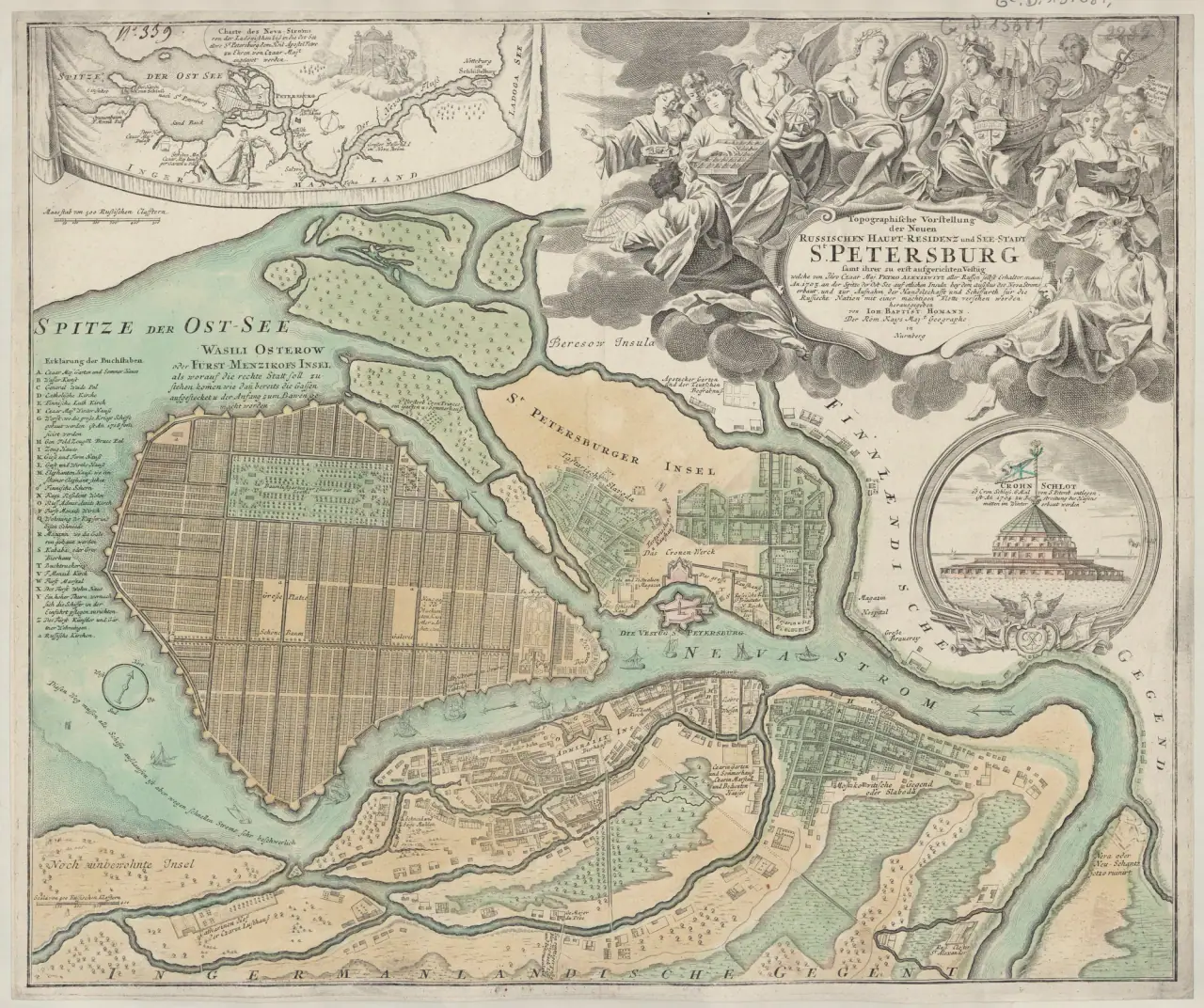
After the learning of the Grand Embassy, conscription, military industry, taxation, and administrative reform advanced repeatedly, and the new capital and church governance linked symbol to institution. The founding of the city in 1703, military production, and taxation advanced together; Poltava changed the war situation, but negotiations and war continued until 1721. The Senate, the colleges, the Holy Synod, and the Table of Ranks belonged to different years and functions. Policies supported one another but also required adjustment; they were not a single unified plan promulgated at once, and implementation still depended on local agents and social cooperation.
03 / CONTEXT & CONSEQUENCEPeople, institutions and alternatives
The monarch made key decisions, bureaucrats, foreign technical specialists, and artisans implemented reform, and peasants and soldiers bore the main costs. Artisans converted technology into producible objects, officials registered and collected, and soldiers and porters bore the actual labor of war. Nobles could gain positions through service and also retained social advantages. Foreign observers saw both learning and repression, and the praise or distaste of any one of them cannot represent the experience of all participants.
Different diplomatic alliances and slower reform offered alternatives, but outcomes cannot be determined, and victory cannot be written backward as the only possibility. During his travels Peter sought a different anti-Ottoman alliance before turning to Sweden; this shows diplomacy was not predetermined. The pace of reform and arrangements for finance and service could also have been chosen differently, but every option was constrained by resources and opponents. There is no evidence that a conservative or more moderate path would necessarily have achieved the same results easily.
04 / CONTEXT & CONSEQUENCEAfter the turning point
Mobilization and administrative capacity increased, while taxes and service obligations, restrictions on movement, and tensions between old and new elites also deepened. Acquiring Baltic ports and great-power status made the new institutions and army size easier to sustain; long-term levies and service obligations also deepened social pressure. Changes in elite manners and education widened the distance from many peasant households. A state's increased mobilizable resources and residents' increased autonomy are different outcomes and must be assessed with separate evidence.
Institutions and symbols influenced the empire, and modernization and social freedom did not always move in the same direction. Later monarchs used Peter's name to justify reform or dynastic legitimacy, so statues, cities, and museums are also political memory. Schools, the navy, and administrative offices persisted, while their operation was continually adjusted by successors. Lasting influence cannot be reduced to a fixed national character from then on, nor can military victory be used to retroactively justify all coercion as necessary.
How the event unfolded
Learning from Europe
The Grand Embassy sought diplomatic, navigational, and technical resources.
War drove reorganization
Fighting made military supply and finance urgent problems.
New status and new institutions
The peace treaty, imperial title, and church reform echoed one another.
Facts supported by evidence
- Saint Petersburg was founded in 1703, and the Battle of Poltava in 1709 changed the course of the war.
- The war ended in 1721 and the title of emperor was accepted; the Table of Ranks was promulgated in 1722.
Major historical interpretations
- The military-fiscal state interpretation emphasizes that reform first responded to the taxation and mobilization demands of long-term war.
- Cultural absorption had both continuity and genuine rupture.
Questions still discussed
- Scholars disagree over whether the reforms were a thorough revolution or an acceleration and institutionalization of seventeenth-century changes.
Peter I
Russian tsar and emperorUsed war to advance military, administrative, and cultural reforms; the reforms also depended on officials, artisans, and conscripted laborers and cannot be attributed solely to the monarch's will.
References and evidence
These materials support this page's account. Check the purpose, perspective and accessible scope of each source. Notes identify the evidential limits of excerpts, summaries and timelines.
- Wolfram Koeppe: St. PetersburgThe Metropolitan Museum of Art · Museum research
Read the article and list of works to check the founding of the city, court, and craft exchange; treated its Westernization rhetoric with caution.
- The Cambridge History of Russia, Volume 2: public abstracts on the imperial periodCambridge University Press · Academic research
Checked governance, estates, women, agriculture, economy, and thought in the public abstracts; this is not a page-by-page review of the whole book.
- The Cambridge History of Russia, Volume 2: public chronologyCambridge University Press · Academic research
Publisher's public PDF, used to check dates and chapter structure; the map insert does not thereby become openly licensed.
- The era of Peter I: accounts by four observersFordham University,Internet History Sourcebooks Project · Primary source
Actually read selections from Burnet, Korb, Gordon, and Rousset, comparing technical learning, suppression of the Streltsy, taxation, and customs; each has foreign-observer and political positions, and hearsay is not treated as eyewitness testimony.
- Russia: A Country Study: body text on the early empireLibrary of Congress, Federal Research Division; CountryStudies.us text mirror · Specialist reference
Read the body text on Peter, court successions, Catherine, and the estate system; absolute assertions such as the economy being completely unable to grow under serfdom are not adopted.