01 / CONTEXT & CONSEQUENCEBefore the event
Contradictions over land, labor, and representation already existed, and the Great War further disrupted supply, finance, and trust. Workers remained connected to rural households, and the land question did not disappear because of industrialization. The army and railways both helped mobilize for war and spread discontent and organizational experience. After the dynasty's abdication, the Provisional Government, the Soviets, and local bodies held different mandates, and who was entitled to decide on war and land became a new political conflict rather than an old problem resolving itself naturally.
War exhaustion, land demands, a legitimacy crisis, and regional autonomy movements overlapped, and the center could not control multiple revolutions. The center lacked stable cooperation, while local groups became increasingly capable of acting. The government's postponement of land decisions and continuation of the war weakened its credibility, and the Kornilov affair further increased the left's opportunities for mobilization. Structural pressures did not automatically select a winner; how parties, the army, and local organizations responded to the crisis determined which alliances could hold or break.
02 / CONTEXT & CONSEQUENCEHow change unfolded
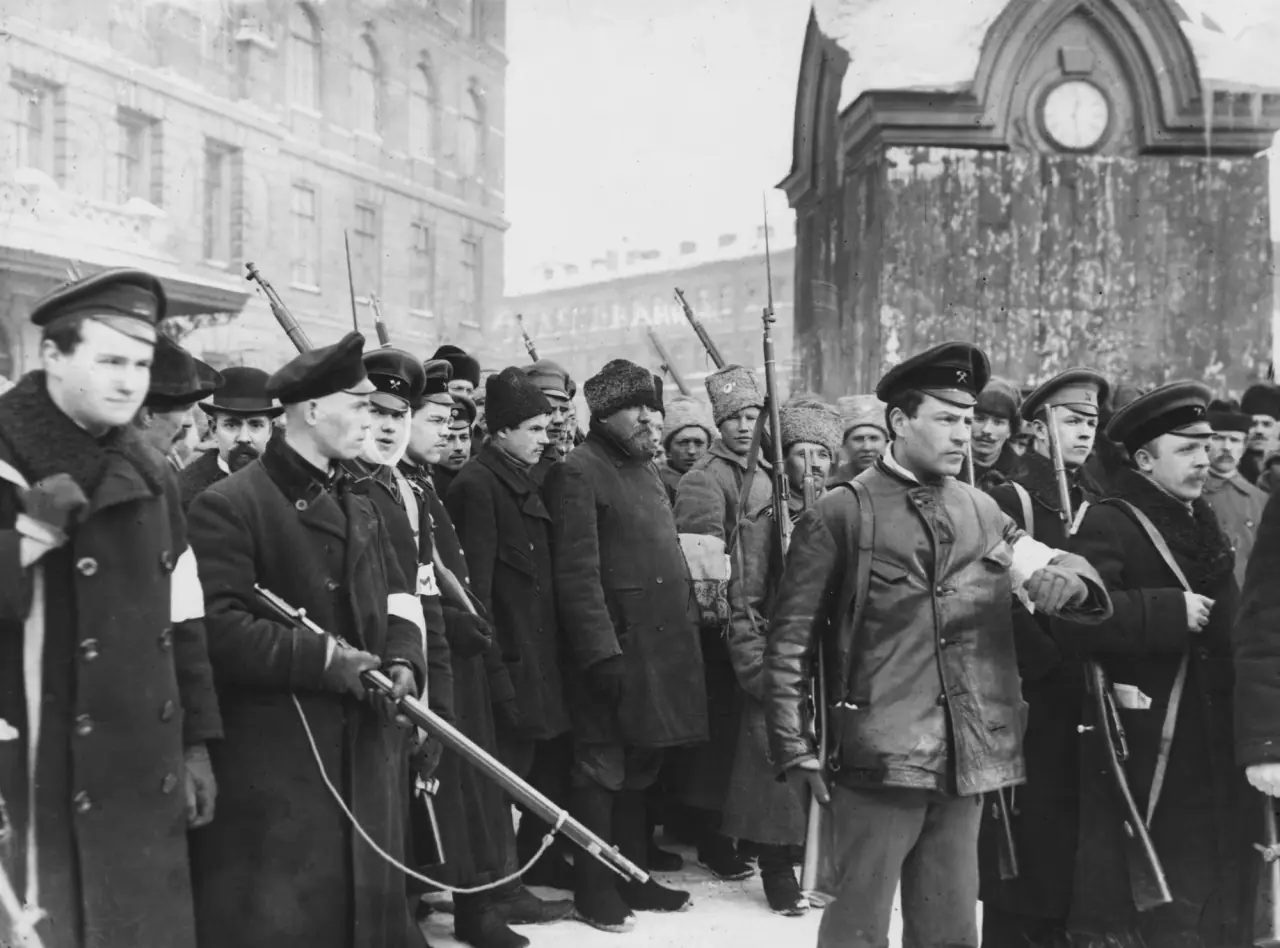
Protests in Petrograd and a mutiny of the garrison made the February crisis spiral out of control, and before October the government's seizure of Bolshevik newspapers accelerated armed action. The immediate process in February included protests over bread prices and supply, women workers taking to the streets, expanding strikes, and the garrison turning; these events left the government unable to rely on the old chain of command. October took place in a different environment of the Provisional Government's loss of credibility, a shift in Soviet forces, and organization by the Military Revolutionary Committee; the two revolutions cannot be assigned the same simple trigger.
After the abdication, dual power coexisted; the war, the July crisis, and the Kornilov affair weakened the middle forces; the Bolsheviks expanded support in key Soviets and seized power, then dissolved the Constituent Assembly, withdrew from the Great War, and fought a civil war. A distinction must be made between the February abdication, dual power, the summer crisis, the October armed action, and the subsequent state-building. The disputes over the Constituent Assembly and land policy did not end when the Winter Palace was occupied, and withdrawal from the Great War also came with major costs. The civil war included multiple local and national fronts and cannot be drawn simply as a single decisive battle between two nationally unified armies.
03 / CONTEXT & CONSEQUENCEPeople, institutions and alternatives
Lenin insisted on insurrection, and Trotsky and others organized action; women workers, soldiers, village communes, and various regions had their own demands and were not passive tools of a single party. The actions of women workers and soldiers brought about the February breakthrough, and the Provisional Government and Soviet leaders determined the scope of their cooperation. Village committees, communes, and returning soldiers organized changes in land, and the Left Socialist Revolutionaries cooperated with the Bolsheviks for a time. Individual leadership mattered greatly, but had practical effect only within these organizations and social demands.
A socialist coalition government, the Constituent Assembly, local self-government, and different war policies all had real support and also obvious obstacles. Every proposal had to deal with the actual armed forces, food, and the continuation of the war, and one cannot assume there was no support simply because it was not realized. The Constituent Assembly and the Soviets also did not represent exactly the same voters or the same moment. The coalition government was not free of disputes and difficulties, but as a path genuinely proposed at the time, it deserves to be explained separately from later outcomes.
04 / CONTEXT & CONSEQUENCEAfter the turning point
A one-party state formed during the civil war; land, territory, and hierarchy were reorganized, and violence and famine devastated society. The new regime redistributed land and promoted social reform, while concentrating power through security agencies, military orders, and the exclusion of competitors. Peasants who received land might still oppose grain requisitioning, and workers might be dissatisfied with labor discipline. The losses caused by famine, epidemic, anti-Jewish pogroms, and other violence cannot disappear from revolutionary history once the outcome was decided.
The revolution influenced labor, parties, and anti-colonial movements worldwide, and both the promise of equality and the legacy of state terror must be examined. The revolution made equality, women's emancipation, and national autonomy worldwide issues, and also left a legacy of party monopoly, terror, and forced state-building. When transmitted elsewhere, these legacies were reinterpreted by different groups. One cannot say that all later Soviet policies were already fixed on the night of October, nor deny the social hopes that genuinely existed at the time because of later repression.
How the event unfolded
February: The collapse of the dynasty
Strikes and mutiny brought about the abdication.
Summer: The crisis escalates
Popular demands, policy, and military order further fractured.
October: The seizure of power
The Military Revolutionary Committee controlled key facilities.
Representation and the war divide
The Constituent Assembly is dissolved and withdrawal from the Great War follows.
Retreat and centralization
Economic policy is adjusted and political space contracts.
Facts supported by evidence
- The February Revolution occurred in March by the Gregorian calendar, and the October seizure of power occurred in November by the Gregorian calendar; the names follow the old calendar.
- The Constituent Assembly was dissolved in 1918, and civil war and foreign intervention expanded.
Major historical interpretations
- Organizing the seizure of power and mass radicalization explain different levels, and the two cannot exclude each other.
- The war made existing contradictions hard to resolve, and specific political choices determined part of the course.
Questions still discussed
- The extent of social support and the degree to which the one-party system was inevitable are debated; later films cannot serve as on-site records.
Vladimir Lenin
Bolshevik leader, Chairman of the Council of People's CommissarsDrove the seizure of power and established centralized rule during the civil war; in 1921 he supported economic retreat. Mass action and later institutions cannot be entirely attributed to one person's design.
References and evidence
These materials support this page's account. Check the purpose, perspective and accessible scope of each source. Notes identify the evidential limits of excerpts, summaries and timelines.
- Lewis Siegelbaum: The October RevolutionSeventeen Moments in Soviet History, a university history-source teaching project · Academic research
Read the signed feature and distinguish the seizure of power in the capital, mass mobilization, and subsequent state-building.
- Lenin introduces the New Economic PolicySeventeen Moments in Soviet History, a university history-source teaching project · Academic research
Read the feature and check the coexistence of the 1921 economic retreat and political centralization.
- Revealing the Russian Archives: Inside the Soviet UnionLibrary of Congress exhibition in cooperation with Russian archives · Archive
Provides documents and translations on grain requisition, repression, censorship, deportation, and reform; the 1992 general introduction's period stance must be read against other research.
- Revealing the Russian Archives: The Soviet Union and the United StatesLibrary of Congress · Archive
Check documents on aid, alliance, the Cold War, and nuclear crises; do not use old statistical ratios that have not been independently reviewed.
- The February Revolution: Streets, women workers, and the garrisonSeventeen Moments in Soviet History, a university history-source teaching project · Academic research
Actually read the feature main text, checking the capital protests, Old Style and New Style dates, the garrison, and the monarch's abdication; did not treat women or the army as a single political bloc.
- The peasant revolution of 1917Seventeen Moments in Soviet History, a university history-source teaching project · Academic research
Actually read the feature main text, checking the sequence among land, village communes, and central decrees; land aspirations are not equivalent to support for every policy of a particular party.
- The double burden: wage labor and houseworkSeventeen Moments in Soviet History, a university history-source teaching project · Academic research
The feature discusses the gap between employment, housework, and the promise of socialist gender equality.