Civil Rights and Social Movements: Turning Rights into Reality
How did a written promise of equality pass through school gates and polling stations?
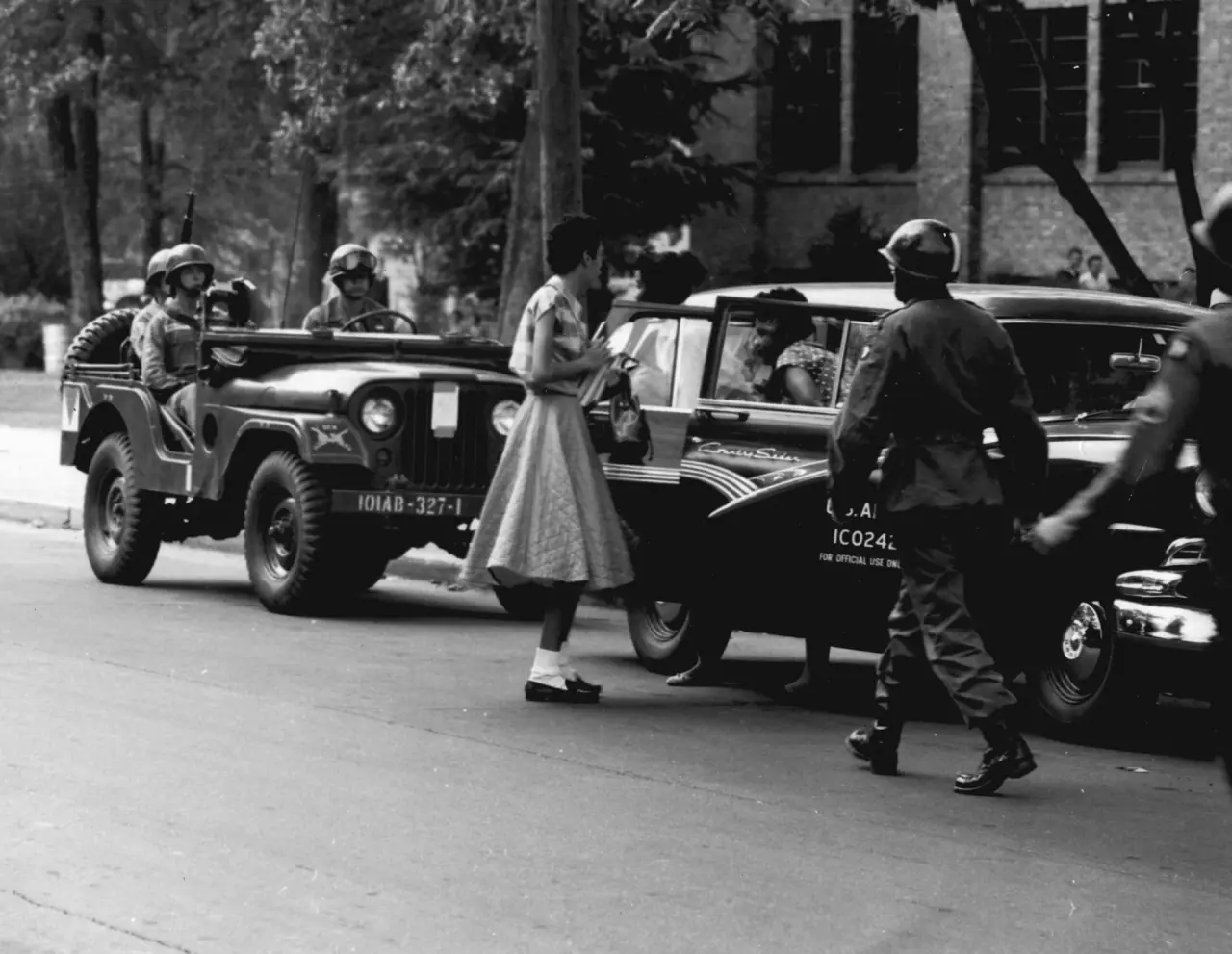
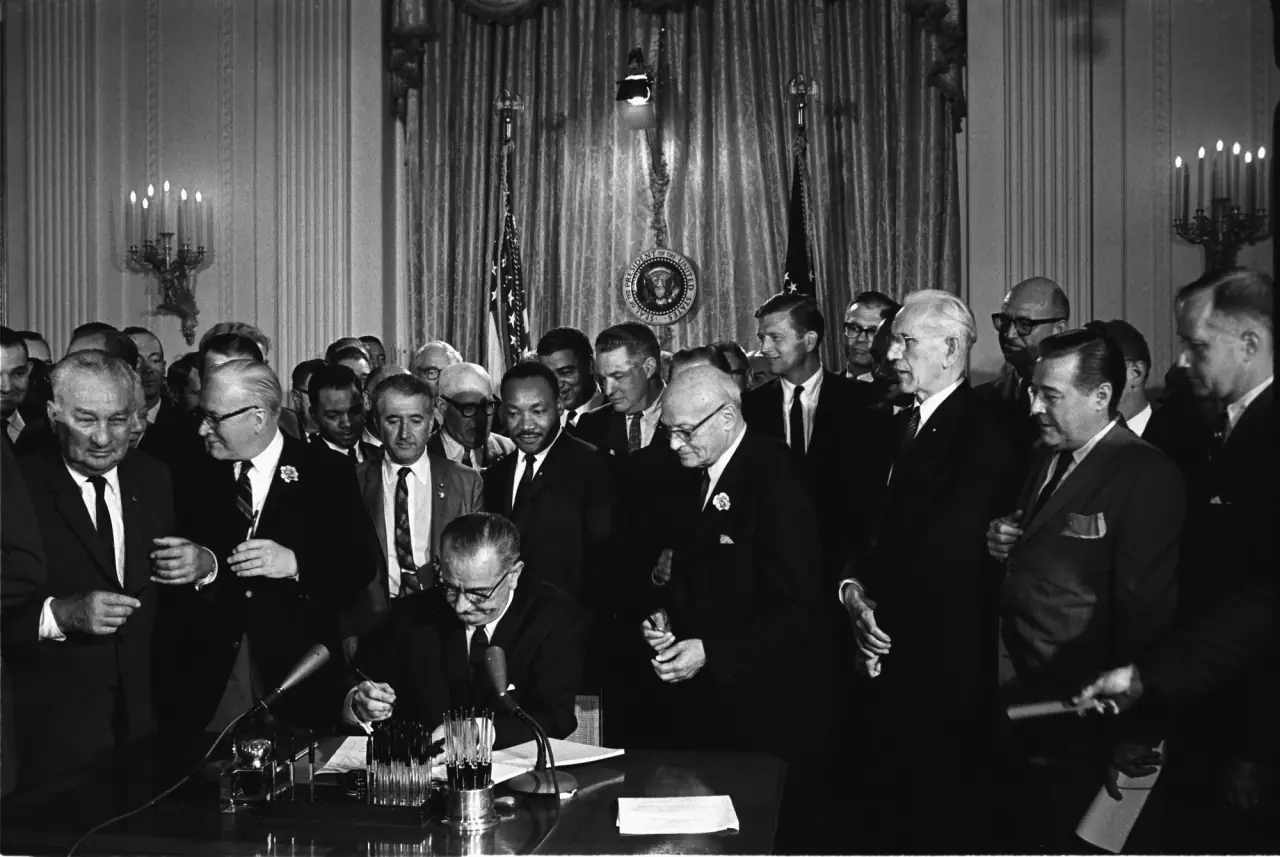
From the Brown decision to the bus boycott, student sit-ins, and voter registration, African American communities turned long-accumulated organizing strength into public protest. Schools, transportation, and voting were not unrelated; together they involved personal safety, employment, dignity, and the qualifications to decide local affairs. The Civil Rights Act of 1964 and the Voting Rights Act of 1965 strengthened federal enforcement but did not automatically end racial and economic inequality. Women's, farmworkers', Latino, and Indigenous movements also developed their own demands and strategies. This thematic chapter, spanning 1954–1975, overlaps with the Cold War and restructuring periods; its purpose is to see how institutional change was driven by the sustained collaboration of ordinary people.
01 / 1954–1975 (thematic chapter)How this era began
The Reconstruction amendments remained in the Constitution, but local segregation, violence, and administrative barriers limited their implementation. Black churches, mutual aid organizations, women, and lawyers sustained community and litigation networks over the long term, and World War II military service and migration changed resources and expectations. 1954 was not the point at which protest began from zero, but a node at which existing action achieved a greater breakthrough in the courts and public space.
Why did this era begin?
The Brown decision rejected racial segregation in public schools, and local implementation met resistance; the Montgomery boycott turned everyday transportation into long-term mobilization. Student sit-ins, Freedom Rides, and voter registration continually changed the agenda; multiple strategies complemented one another and also involved disputes. The movement was never a process of one leader delivering speeches in succession; organizational maintenance and the risk borne by ordinary participants were equally crucial.
02 / 1954–1975 (thematic chapter)Who held power
Local governments and police often upheld segregation, while federal agencies, courts, and Congress expanded intervention under pressure, and their positions were not always consistent with one another. Communities sought rights through organization, litigation, and media, but visibility could also concentrate attention on a few leaders. Women and young people created important decision-making and communication networks, and their influence cannot be measured only by whether they held formal leadership positions.
What tensions existed within the era?
Nonviolence, litigation, elections, and more radical community control each had supporters, and the movement was never permanently unified. Class, gender, and local experience shaped demands, and federal support could also stem from political pressure and international image. Presenting disagreements does not deny the shared struggle for equality; it shows how collective action constantly adjusted amid different risks and opportunities.

03 / 1954–1975 (thematic chapter)How society worked
The pursuit of jobs and freedom stood side by side in the 1963 March, showing that the movement did not only demand entry into the same schools or restaurants but also cared about wages and living conditions. Farmworker organizing linked labor, immigrants' circumstances, and consumer boycotts. Legal anti-discrimination and collective bargaining addressed different problems, and the opening of public facilities cannot be used to infer that differences in poverty, wealth, and labor power had disappeared.
How did ordinary people live?
Boycotts meant walking, carpooling, lost wages, and possible retaliation, and voter registrants also faced dismissal and violence. Women provided transportation, food, shelter, and organizational contacts, while students took direct action on campuses and in the streets. Only by writing out these everyday conditions can one understand the time and resources sustained struggle required, and avoid leaving history with only a few photographs of speakers on a podium.
04 / 1954–1975 (thematic chapter)Where change began
The laws of 1964 and 1965 pushed anti-discrimination and voting protections into a new phase of enforcement, after which housing, poverty, and policing remained targets of struggle. By 1975, Native American self-determination legislation provided another kind of institutional space, and the peoples concerned did not therefore abandon sovereignty claims. The end of the thematic chapter marks only the scope of observation, not a declaration that the civil rights movement was complete or that all groups shared the same outcomes.
Milestones that changed direction
1954: Brown v. Board of Education
The Supreme Court rejected racial segregation in public schools, but did not immediately end desegregation everywhere; local resistance made enforcement and personal safety problems communities still had to fight for.
1955: Montgomery bus boycott
The bus boycott depended on women's organizations, carpools, and local communities operating continuously, turning daily travel into political action; it cannot be reduced to one person refusing to give up her seat, after which legislation changed things automatically.
1960: Student sit-in movement
Young people challenged commercial segregation through sit-ins, and organizing and training expanded direct action; participants also bore the risks of arrest, schooling, and employment, and local conditions shaped strategy.
1963: March on Washington
Jobs and freedom stood side by side at the March on Washington, showing that demands included economic life; a national rally built on long-term local action cannot be taken as the whole movement.
1964: Civil Rights Act passed
The Civil Rights Act provided new federal guarantees in areas such as public facilities, education, and employment, while enforcement and litigation still had to continue; its signing did not mean housing and wealth disparities ended at the same time.
1965: Selma and the Voting Rights Act
Local registration efforts and police violence in Selma drove voting rights legislation, and the original law established tools for federal intervention; later amendments and judicial changes cannot be projected backward as the original rules of 1965.
1975: Native American self-determination legislative milestone
The self-determination and education assistance law expanded institutional space for Native organizations to participate in and take on some public services, and cannot be summarized as meaning all sovereignty and land issues were resolved.
What we know
The texts of the Brown decision, the Civil Rights Act, and the Voting Rights Act state their respective scope and enforcement tools, while the Selma archives record local action and national response. Historical research on women organizers supplements leader-centered narratives. One march in a photograph is not the whole movement, and the original 1965 statutory text cannot be presented without explanation as the full set of rules still in force unchanged in 2024.
Questions still debated
How much grassroots and national organizations, the media, and the federal government each mattered can be compared through local archives and time series. The harder question is how to measure equality: ballots, public facilities, employment, and wealth offer different scales. The demands of African Americans, Latinos, and Native peoples were both interconnected and grounded in different sovereignty and labor contexts, and should not be merged into one civil rights story without internal differences.
Legacies for later generations
Civil rights legislation and community organizing changed public participation and provided experience and legal language for other rights efforts. The gains of reform still depended on court interpretation, administrative enforcement, and organizational capacity, and could expand or be constrained. History should explain how legal guarantees were formed and the distance between them and social outcomes, and later political divisions cannot be used to retroactively erase the concrete rights won at the time.
References and evidence
These materials support this page's account. Check the purpose, perspective and accessible scope of each source. Notes identify the evidential limits of excerpts, summaries and timelines.
- The Civil Rights Act (1964)U.S. National Archives · Primary source
Statutory protections in public accommodations, employment and other areas. Legislation must be distinguished from enforcement.
- The Voting Rights Act (1965)U.S. National Archives · Primary source
Federal enforcement mechanisms and statutory provisions. This account concerns historical enactment and does not assert that every provision remained unchanged in force through 2026.
- The Selma MarchesU.S. National Archives · Archive
Connections among the local voting-rights movement, police violence and federal legislation.
- Native Knowledge 360°: Essential UnderstandingsSmithsonian National Museum of the American Indian · Museum research
An educational framework developed with Indigenous participation, emphasizing social diversity, sovereignty, continuity and contemporary life.
- Milestone Documents in American HistoryU.S. National Archives · Archive
A thematic navigation entry for locating materials. Specific dates and institutional conclusions are cross-checked against documents, collections and substantive entries listed in this chapter. A directory does not establish an account of an entire period.
- Brown v. Board of Education (1954)U.S. National Archives · Primary source
The institution that produced a source and the nature of its text must be distinguished from what it describes. A source link does not mean that every related archive has been made public.
- Women Organizers in the African American Civil-Rights MovementU.S. National Park Service · Specialist reference
The institution that produced a source and the nature of its text must be distinguished from what it describes. A source link does not mean that every related archive has been made public.
- Original Indian Self-Determination and Education Assistance Act of 1975U.S. Government Publishing Office · Primary source
Public Law 93-638, beginning at 88 Stat. 2203. Distinguish declarations, definitions and contracting provisions. The act did not resolve all sovereignty disputes.
- Dolores HuertaU.S. National Park Service · Specialist reference
The institution that produced a source and the nature of its text must be distinguished from what it describes. A source link does not mean that every related archive has been made public.
At the end, bring this chapter to a close.