The Great Depression and the New Deal: Redefining Security
When the market cannot provide work, what responsibility should the state bear?
The expansion of consumption, credit, and investment in the 1920s did not eliminate agricultural hardship and financial fragility, and the 1924 immigration system further defined who could enter the country. After the market crash of 1929, banking crises, unemployment, and contracting demand turned economic shock into a long-term social disaster. Roosevelt's New Deal expanded the federal role through relief, public works, financial rules, and labor protections, while families and unions actively sought aid and work. Institutional innovation did not equal nationwide equal protection; agricultural and domestic labor, among others, were initially excluded from several core insurance or labor provisions. The recession of 1937 showed that recovery remained unstable, and wartime mobilization subsequently changed the economic environment.
01 / 1920–1939How this era began
During the boom, household consumption and investment expanded, but agricultural prices, debt, and income distribution left many people without a buffer. Immigration quotas and racialized entry rules shaped the boundaries of labor and family reunification. The 1920s cannot be summarized as everyone prospering first and then suddenly suffering; regional, occupational, and ethnic differences that already existed before the crisis influenced the later distribution of unemployment and relief.
Why did this era begin?
The stock market decline was not the sole cause of the Great Depression; bank failures, monetary and credit contraction, and falling consumption and investment transmitted the shock to one another. Early responses failed to restore confidence, and in 1933 the new administration quickly introduced banking, relief, and public works measures. The New Deal was a set of programs continually adjusted under uncertainty, and cannot be written as a unified economic plan fully designed at the start of the crisis.
02 / 1920–1939Who held power
The president and Congress expanded federal spending and regulation, while courts, state governments, and local implementing agencies shaped policy boundaries. Organizing by unions and the unemployed brought labor and relief onto the agenda, and business and conservative forces continued to oppose it. The growth of federal capacity did not eliminate local racial power, and whether residents could obtain work or assistance still depended on implementing agencies and legal eligibility.
What tensions existed within the era?
How relief should be coordinated with work, local autonomy, and finance provoked intense controversy; expanding collective bargaining also changed relations between businesses and workers. Racial and occupational exclusions limited the universality of policy, and women were often treated as dependents rather than independent workers. Economic recovery and equitable security are not the same indicator; a policy may ease a crisis without changing the structure through which certain groups bear risk.
03 / 1920–1939How society worked
The New Deal sought to stabilize banks, provide work, and secure incomes, and recognized some collective bargaining rights through a labor relations system. Social Security created a framework for old-age and other assistance, but different programs had different scopes and financing methods. The exclusion of agricultural and domestic labor is especially important; the 1935 legislation cannot be written as all workers immediately receiving the same retirement or unemployment insurance.
How did ordinary people live?
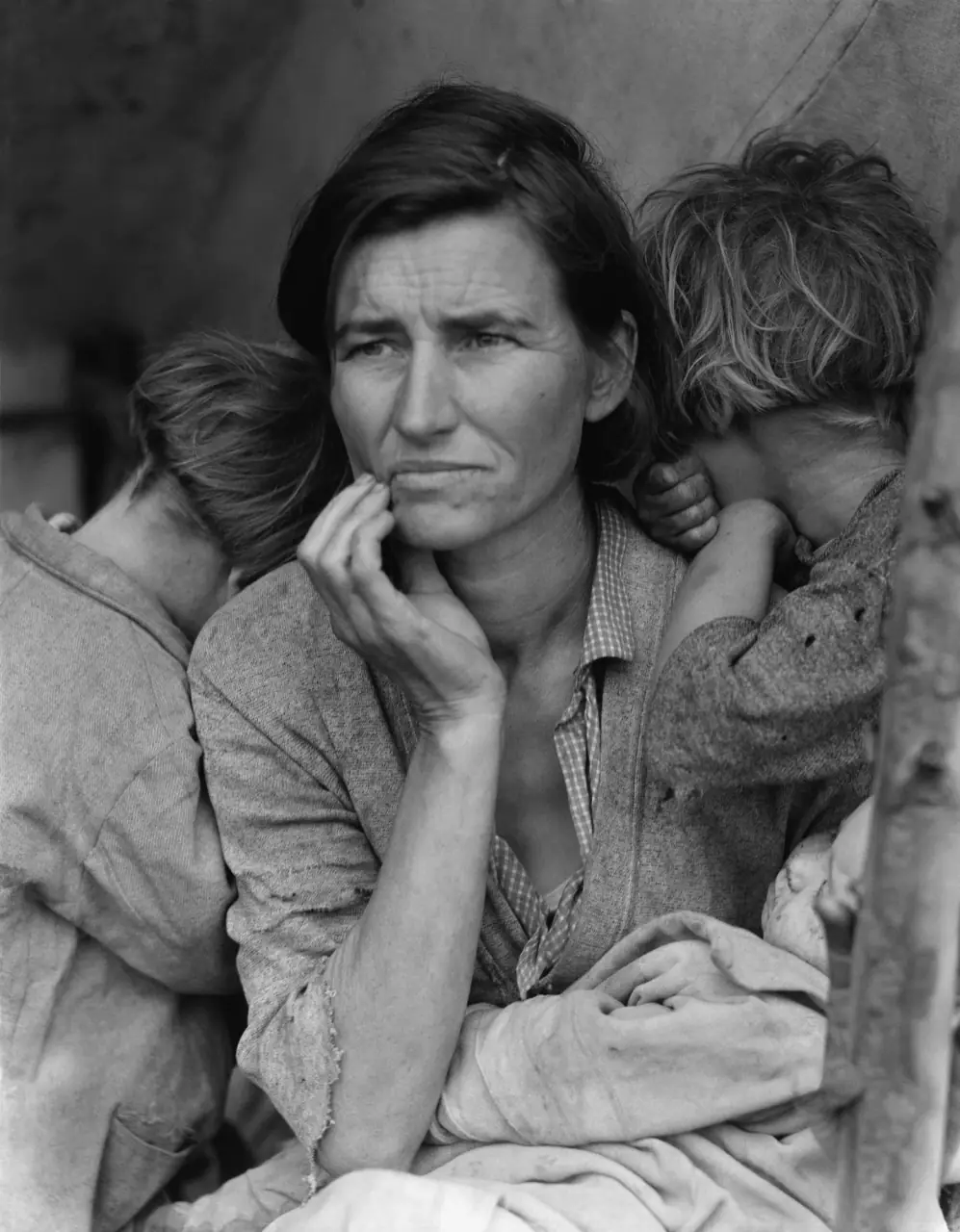
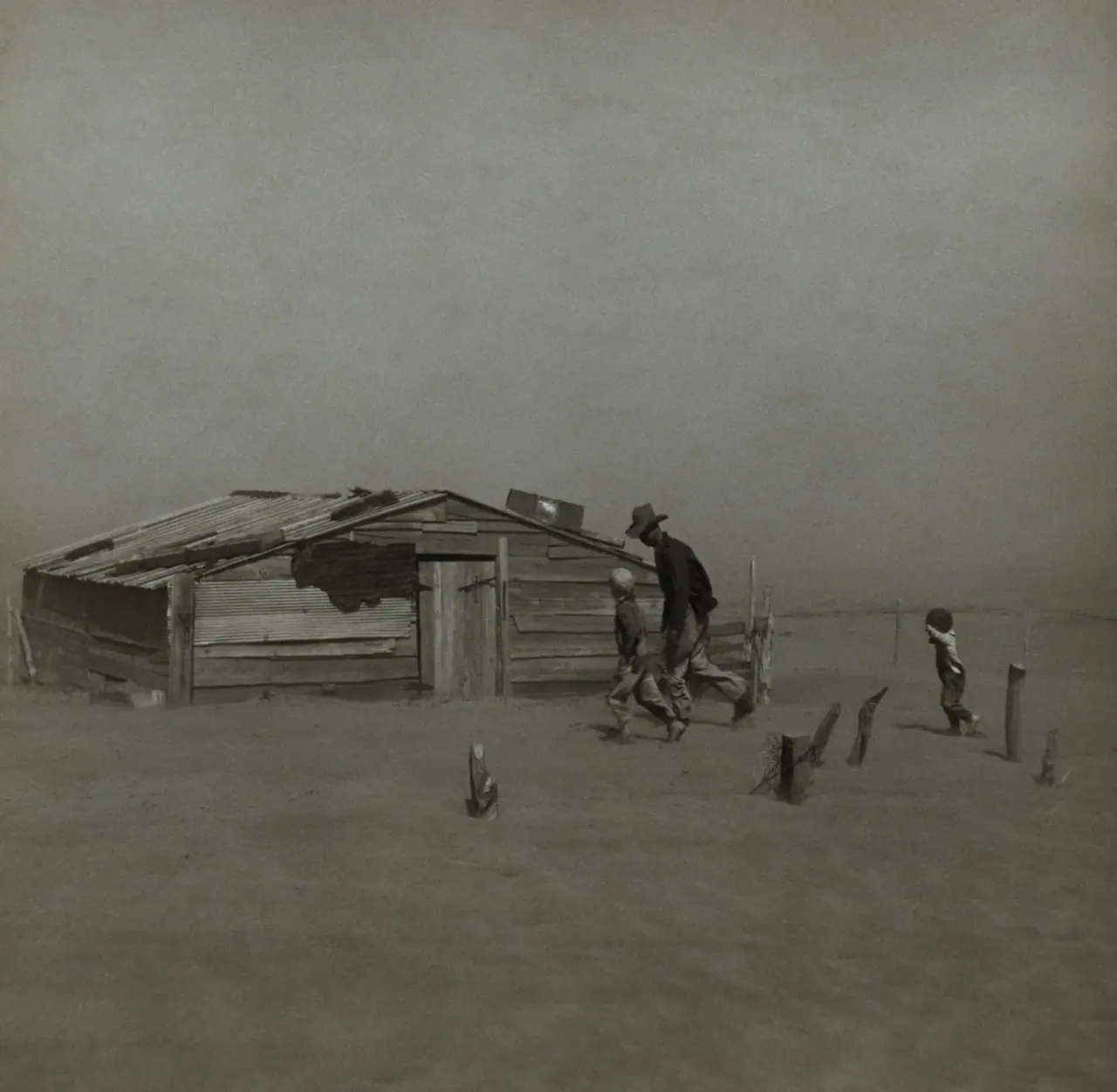
Unemployment and loss of land forced families to migrate, share housing, and redistribute caregiving and paid labor, and children were also affected by disruptions to nutrition and education. Public works provided wages and infrastructure, while agricultural laborers could still face low pay and unstable housing. Photographs by Lange and others brought these conditions into public view, but those photographed should not be fixed only as silent symbols in relief propaganda.
04 / 1920–1939Where change began
The recession of 1937 showed that the economy had not achieved stable recovery, and the relative roles of fiscal, monetary, and market factors still require comparison. The European war of 1939 and the subsequent U.S. mobilization again changed production and employment. War is not described here as a universal remedy that eliminated all social problems; expanded wartime employment, restrictions on freedom, and racial discrimination will appear together in the next chapter.
Milestones that changed direction
1924: Immigration quotas and exclusions strengthened
Immigration law tightened country-of-origin quotas and excluded many Asian immigrants who could not be naturalized; statutory classifications affected family and labor mobility, and not all immigrants can be treated as having entered under equally open conditions.
1929: Stock market crash
The stock market crash occurred within a broader contraction, after which banking crises, credit, and falling demand amplified one another; a single day's market decline cannot be taken as the entire cause of the Depression.
1933: The New Deal begins
The Roosevelt administration introduced measures on banking, relief, and public works; the New Deal consisted of programs at different stages, and policy goals, appropriations, and the protection families actually received were not entirely consistent.
1935: Social Security and labor relations legislation
Social security and labor relations institutions expanded federal responsibility, while some agricultural and domestic labor remained excluded from core protections; formal reform and coverage must be compared item by item.
1937: Economic recession returns
The economy contracted again, showing that recovery was not yet secure. The relative roles of fiscal policy, monetary policy, and private activity require further analysis; one should not declare the crisis over merely under the name of the New Deal.
What we know
The original texts of the Social Security Act and the labor relations law allow verification of program scope and employment definitions; Federal Reserve historical research provides explanations of financial transmission; and library materials preserve multiple types of records on migration, unemployment, and public works. Policymakers' own retrospectives cannot represent all families; propaganda photographs must also be read in light of the commissioning of the shoot, the framing, and the identity of those photographed, rather than by emotional impact alone.
Questions still debated
How the New Deal affected recovery, why the crisis lasted so long, and what roles fiscal policy, monetary policy, and war mobilization each played are research debates with clear objects of comparison. One cannot declare an institution wholly successful or failed on the basis of a single unemployment curve. Presenting policy exclusions alongside its innovations in protection helps explain its limits and also avoids erasing the breakthroughs of the time with later institutional expectations.
Legacies for later generations
The New Deal left an important institutional foundation for federal regulation, social insurance, and labor organization, and also left problems of uneven coverage by occupation, race, and gender. Residents' expectations of government responsibility changed, and later debates therefore often centered on the scope of protection and sources of funding. In evaluating its impact, one should distinguish three different tasks: relieving urgent hardship, building long-term institutions, and ending the economic depression.
References and evidence
These materials support this page's account. Check the purpose, perspective and accessible scope of each source. Notes identify the evidential limits of excerpts, summaries and timelines.
- A Research Guide to the Great Depression and New DealLibrary of Congress · Archive
A thematic navigation entry for locating materials. Specific dates and institutional conclusions are cross-checked against documents, collections and substantive entries listed in this chapter. A directory does not establish an account of an entire period.
- The Social Security Act (1935)U.S. National Archives · Primary source
The original 1935 statute. Distinguish employment definitions, old-age benefits, unemployment and other assistance by Title. Check agricultural and domestic-service exclusions in particular; this was not immediate insurance for everyone.
- Milestone Documents in American HistoryU.S. National Archives · Archive
A thematic navigation entry for locating materials. Specific dates and institutional conclusions are cross-checked against documents, collections and substantive entries listed in this chapter. A directory does not establish an account of an entire period.
- The Chinese Exclusion Act (1882)U.S. National Archives · Primary source
Federal legislation concerning Chinese labor immigration and naturalization, and its aftermath. It cannot be summarized as a ban on every Chinese person entering at that time.
- The Immigration Act of 1924 and National-Origins QuotasOffice of the Historian, U.S. Department of State · Specialist reference
The institution that produced a source and the nature of its text must be distinguished from what it describes. A source link does not mean that every related archive has been made public.
- Financial and Monetary Mechanisms of the Great DepressionFederal Reserve History · Specialist reference
The institution that produced a source and the nature of its text must be distinguished from what it describes. A source link does not mean that every related archive has been made public.
- The National Labor Relations Act (1935)U.S. National Archives · Primary source
Legislative context and an online statutory transcription incorporating later amendments. Current definitions should not all be projected back onto 1935. Agricultural and domestic-service coverage also requires separate comparison with the original act and Social Security Act.
At the end, bring this chapter to a close.