Reconstruction: How to Live After Freedom
With free status, could one own land, vote, and be safe?
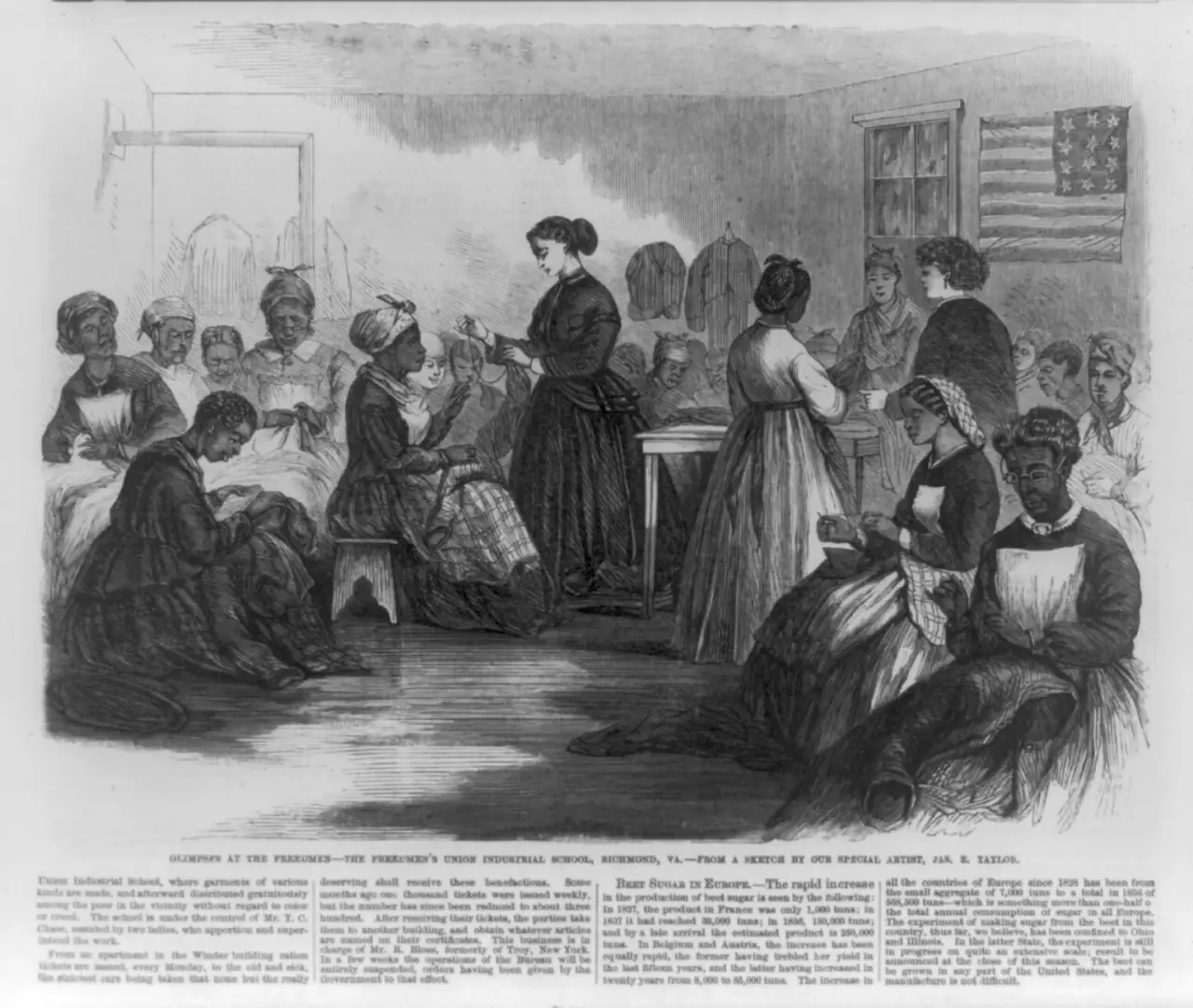
After 1865, the meaning of freedom expanded from no longer being held as property to family, labor, land, education, and political standing. Freedpeople established schools, churches, and organizations, voted, and entered government; Congress and the federal army sought to guarantee these changes, and the Thirteenth through Fifteenth Amendments also rewrote the relationship between the state and citizens. White supremacist violence, local restrictions, and economic dependence steadily eroded reform, and land redistribution in particular was never broadly guaranteed. The contraction of federal support in 1877 was an important turning point, but it was not the day Reconstruction activity ended everywhere. This chapter reads the commonly used political periodization together with longer social processes, so that failure is not written as though freedpeople had never created institutions.
01 / 1865–1877How this era began
The Civil War destroyed the Southern economy and ruling order, and enslaved people had already claimed room to act during the war. The federal government had to decide how the former Confederate states would recover political standing while also determining the relationship between former slaveholders and freedpeople. Land, wages, family, and governmental rights were intertwined, so the goal of restoring national unity could not substitute for the specific guarantees needed to reorganize a free society.
Why did this era begin?
The Freedmen's Bureau intervened in daily life through relief, education, legal aid, and labor contracts, while Congress and the president clashed over the direction of Reconstruction. The Reconstruction Act of 1867 and military arrangements made new state constitutions and political participation possible. Change was not delivered one-way from the center; freedpeople's own building of schools, assemblies, and political participation likewise created the public space that federal policy sought to protect.
02 / 1865–1877Who held power
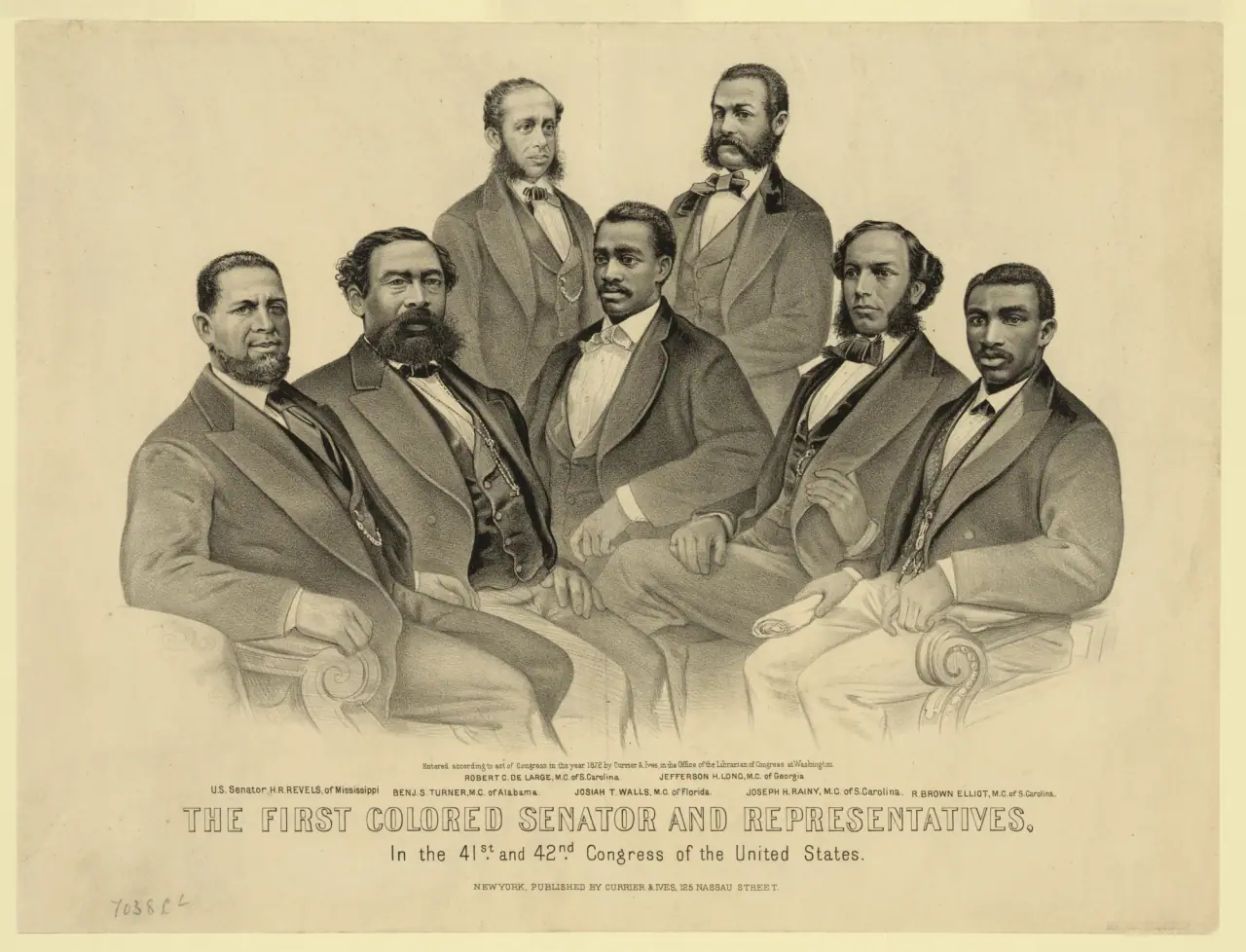
Congressional Reconstruction and the amendments expanded federal guarantees, and Black men gained new political standing and entered local and state institutions. State governments, the army, and the courts could nonetheless take differing positions on enforcing rights, and women still did not generally obtain the vote. White supremacist organizations suppressed participation through terror, showing that formal standing can function only when connected to personal safety, organizational capacity, and actual enforcement.
What tensions existed within the era?
A vast gap existed between constitutional principles and local power, and violence, employment control, and administrative evasion together compressed political opportunities. Different Black communities also made different judgments about land, cooperation, and political strategy. Describing Reconstruction as manipulation by an alien government or as Black incapacity for governance recycles the counter-Reconstruction political narrative, and its authors' interests, time of formation, and counterevidence must be examined.
03 / 1865–1877How society worked
Freedpeople wanted to work autonomously and acquire land, while former slaveholders sought to control labor and restore production. Sharecropping, debt, and crop liens drew many families into new relations of dependence, and wage contracts did not necessarily mean equal negotiation. The abolition of slavery was a fundamental change, but writing only that free labor replaced slave labor would miss the continuity of property and credit power.
How did ordinary people live?
Searching for and reuniting family members, legally registering marriages, and building schools and churches were everyday ways freedpeople created freedom. Education served children and also supported adults in reading contracts and participating in politics. Women bore family, labor, and community organizing responsibilities yet often do not appear on voting rolls; measuring all Reconstruction achievements by the number of officeholders would miss this sustained social construction.
04 / 1865–1877Where change began
The political arrangements of 1877 and the contraction of federal military support weakened Southern Republican governments, but this does not mean the army left the South entirely or that Black political life vanished that day. Disfranchisement and racial segregation continued in later years at differing paces in different places. This chapter uses 1865–1877 to mark the core phase of political Reconstruction while still explaining that its social practice and reversals extended over a longer period.
Milestones that changed direction
1865: Freedmen's Bureau Established
The Freedmen's Bureau intervened in Southern life through relief, education, legal aid, and labor contracts; freedpeople's own building of schools and reconstruction of families was equally important, and they were not one-way recipients of federal assistance.
1866: Congress Proposes the Fourteenth Amendment
Congress submitted rules on citizenship, due process, and equal protection to the states for ratification in response to rights questions during Reconstruction; proposing the amendment and its ratification in 1868 are not the same point in time.
1868: Fourteenth Amendment
The Fourteenth Amendment established rules on birth and naturalized citizenship, due process, and equal protection, but how it was subsequently interpreted and applied to the states remained contested for a long time.
1870: The Fifteenth Amendment
The Fifteenth Amendment prohibited restricting voting on the basis of race, color, and prior condition of servitude, expanding Black men's political participation; violence and subsequent evasion did not automatically disappear because of the text.
1877: Contraction of Military Support
Federal military support for Republican governments in the South contracted, and white supremacist rule expanded further; not all troops were withdrawn, nor did Black political and social construction stop at the same time.
What we know
The text of the amendments distinguishes abolition, citizenship, equal protection, and voting rights, while materials such as those on the Freedmen's Bureau show how rights entered contracts and schools. The National Park Service uses a broad periodization extending to 1900, which is not the same question as the common 1877 political dividing line. Sources should be checked against local practice; a single federal statute cannot establish that freedpeople nationwide immediately obtained land or safety.
Questions still debated
When Reconstruction began or ended depends on whether one takes wartime emancipation, state politics, or longer social change as the object of observation. Its failure also cannot be explained solely by the North losing interest; violence, economic resources, and institutional enforcement all played a part. Different periodizations can be presented side by side, but racist judgments about Black political capacity should not be packaged as academic debate on a par with archival evidence.
Legacies for later generations
The Reconstruction amendments left a key foundation for later civil rights jurisprudence and legislation, and schools, churches, and community organizations retained continuing strength. The reconstruction of white supremacist rule, by contrast, shows that legal achievements can be weakened by enforcement, interpretation, and violence. Evaluating this period requires seeing both the real achievements of the democratic experiment and the failure of the conditions protecting it, and it must not be written as an egalitarian reform that never happened.
References and evidence
These materials support this page's account. Check the purpose, perspective and accessible scope of each source. Notes identify the evidential limits of excerpts, summaries and timelines.
- Institutions and Society during ReconstructionU.S. National Park Service · Specialist reference
The Thirteenth through Fifteenth Amendments, freed people and gaps in institutional implementation.
- Milestone Documents in American HistoryU.S. National Archives · Archive
A thematic navigation entry for locating materials. Specific dates and institutional conclusions are cross-checked against documents, collections and substantive entries listed in this chapter. A directory does not establish an account of an entire period.
- Original Text of the Fourteenth AmendmentU.S. National Archives · Primary source
The institution that produced a source and the nature of its text must be distinguished from what it describes. A source link does not mean that every related archive has been made public.
- Original Text of the Fifteenth AmendmentU.S. National Archives · Primary source
The institution that produced a source and the nature of its text must be distinguished from what it describes. A source link does not mean that every related archive has been made public.
At the end, bring this chapter to a close.