The Independence Revolution: Whose Freedom?
Why did a revolution that declared all people equal still preserve slavery?
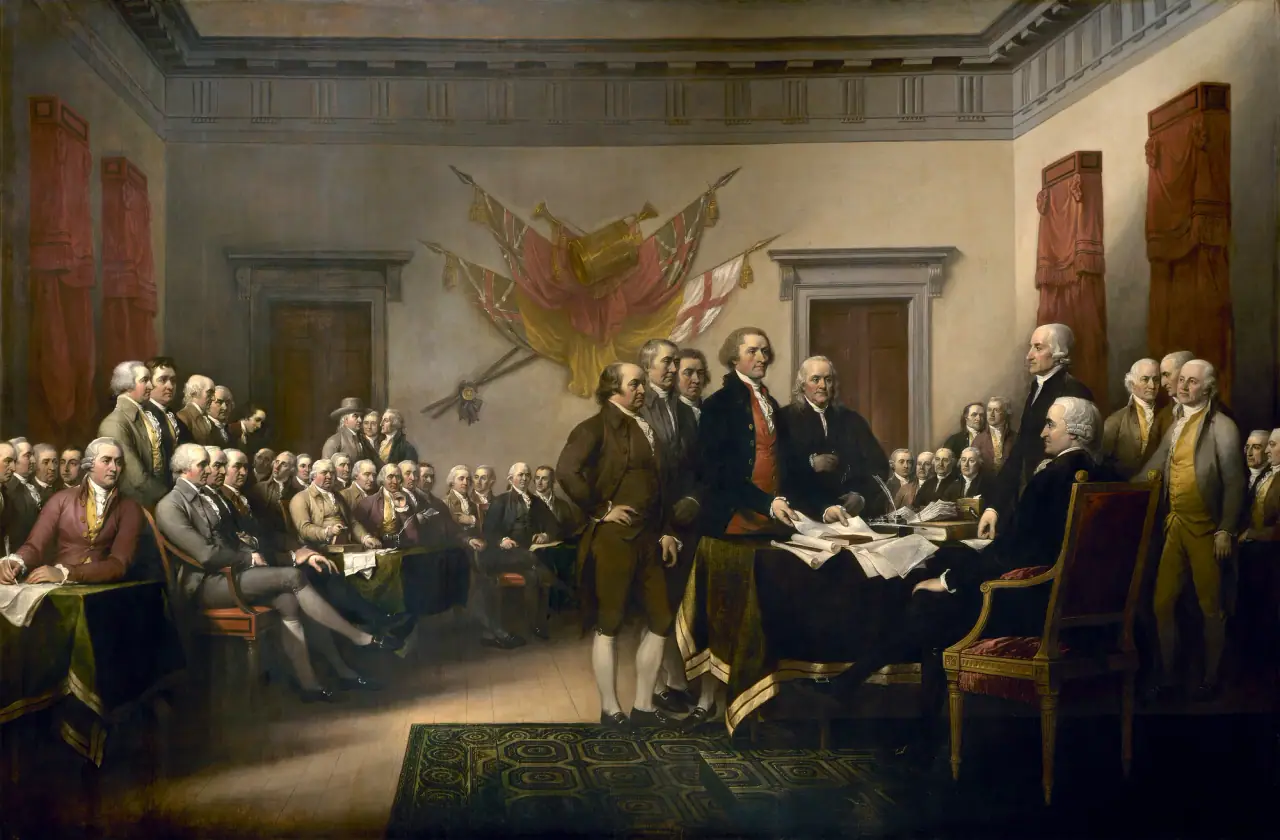
After 1763 Britain tightened taxation and imperial administration, and colonial resistance gradually turned into armed conflict. The 1776 Declaration of Independence expressed new political principles in terms of equality, rights, and the consent of the governed; armies, local organizations, and external forces such as France then made independence a reality. The war was also an internal division, as Loyalists, Indigenous nations, and enslaved people chose paths according to their own opportunities for safety and freedom. The 1783 treaty recognized American independence but did not resolve war debt, governmental authority, or the scope of rights. The republic thus gained a beginning, yet still had to answer which people its declared principles could actually include.
01 / 1763–1783How this era began
The Seven Years' War gained Britain more territory in North America and also increased its financial and garrison burdens. Colonial elites were accustomed to participating in taxation through local assemblies but still relied on imperial trade and military protection. The two sides had not always been incompatible; the problem was who could decide expenses, frontier rules, and representation after the war, and the existing relationship gradually could not accommodate these conflicting demands.
Why did this era begin?
The Stamp Act controversy, boycotts, and the Boston Tea Party promoted intercolonial ties, while British punitive measures strengthened fears of centralized power. After the fighting at Lexington and Concord in 1775, military organizations and the Continental Congress took on more and more governing tasks. The independence position expanded during the conflict; it was not a slogan that automatically won unanimous support from all residents once announced.
02 / 1763–1783Who held power
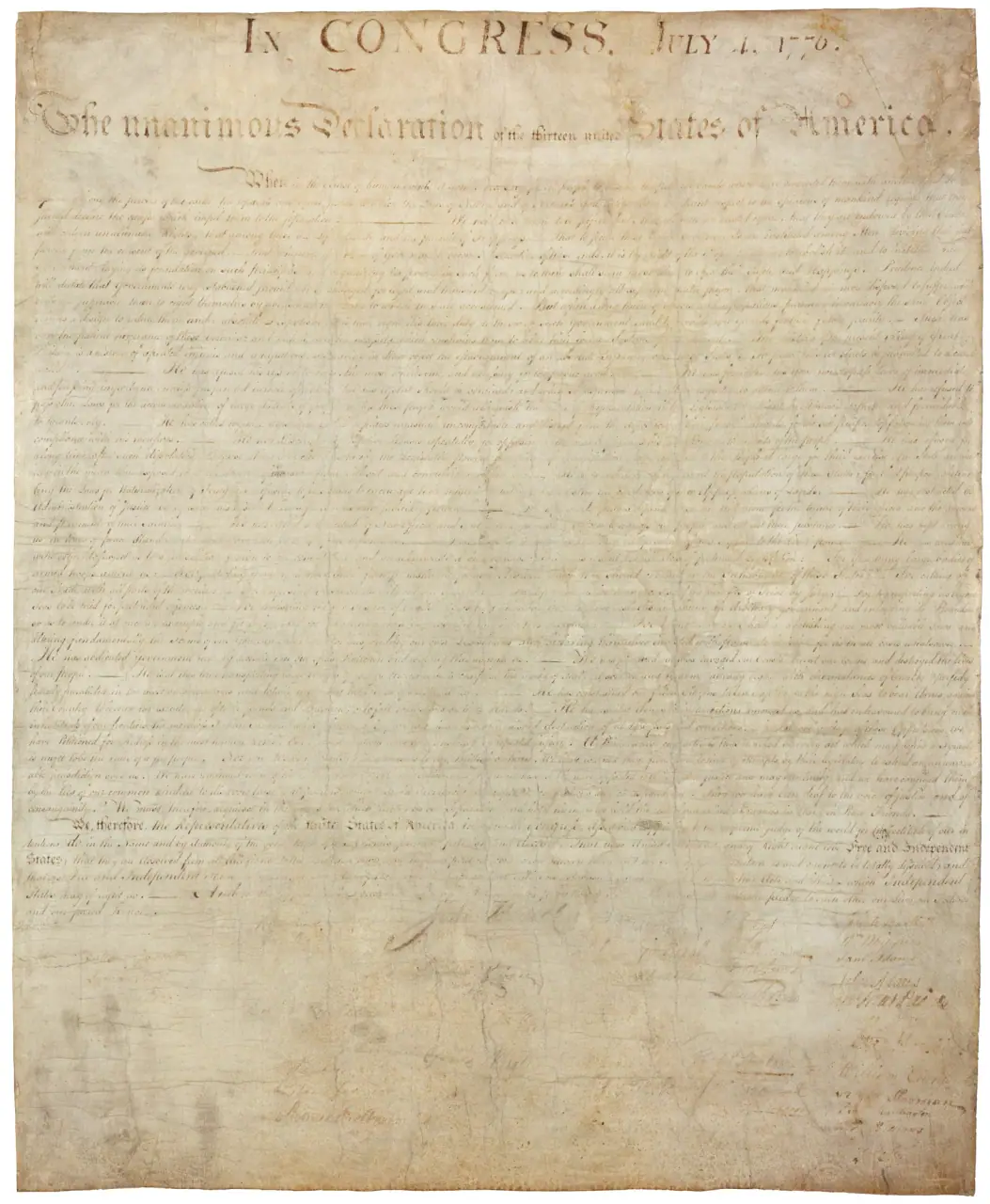
The Continental Congress and the states created new political institutions, but military spending, conscription, and supplies still required mobilization by local governments and communities. Leaders put forward a language of universal rights, yet voting and officeholding rules mostly continued to be restricted by property, gender, and race. Independence was therefore both a break from imperial authority and an ongoing argument over who could represent the people and how states and the center would cooperate.
What tensions existed within the era?
The equality in the Declaration conflicted with the slavery that continued to exist, and colonists' pursuit of western land could also violate Indigenous sovereignty. Within the revolution there were also divisions between radical mobilization, property order, and conservative stability. Pointing out these contradictions does not deny the institutional breakthrough; rather, it explains why the same language of rights was later still used by the excluded to challenge the republic.
03 / 1763–1783How society worked
The war disrupted trade and created currency and debt pressures, and armies needed agricultural goods, manufactured goods, and transport labor. Merchants, farmers, and households bore different consequences from requisitions and inflation, and slave plantations did not leave the economy because of the Declaration. French aid and the international war expanded resources and pressures, so victory and defeat cannot be explained solely by the courage or tactics of colonial troops.
How did ordinary people live?
Women ran households and shops, made military supplies, and took part in boycotts, while soldiers and civilians faced separation, disease, and shortages. Enslaved people used the battle lines and promises from the British or the revolutionary side to seek a way out, while Indigenous nations assessed which alliance better served land security. Loyalist families were excluded or migrated, showing that the revolutionary experience was far more complex than the image of community in victory celebrations.
04 / 1763–1783Where change began
The Battle of Yorktown and the international military situation brought about negotiations, and the 1783 Treaty of Paris recognized American independence. The treaty dealt with territory and national recognition among empires and did not obtain the consent of all affected Indigenous nations. After the fighting stopped, the problems of debt, veterans, commerce, and central authority became pressures on political construction, and independence did not automatically bring stable governance.
Milestones that changed direction
1765: Stamp Act crisis
Conflict over the Stamp Act and representation promoted boycotts and intercolonial cooperation; the dispute between Parliament's taxing power and local consent was not yet directly equivalent to a unanimous demand for independence.
1773: Boston Tea Party
The Tea Act protests and Britain's punitive measures further narrowed the room for compromise; goods, ports, and public protest became sites of political struggle, not only debates in Parliament.
1775: Armed conflict breaks out
The fighting at Lexington and Concord turned the resistance into war, and local militias and the Continental Congress needed to organize resources; the outbreak of conflict still did not immediately end all efforts at reconciliation.
1776: Declaration of Independence
The Continental Congress adopted the Declaration on July 4, grounding the claim to independence in rights and the consent of the governed. Adopting the text, signing the parchment, and actually realizing its principles were distinct processes.
1778: France allies with the United States
The French alliance brought the North American war into a broader imperial rivalry; naval power, military supplies, and diplomatic resources shaped the outcome, and the colonial forces did not win the war in isolation.
1783: Treaty of Paris
The Treaty of Paris recognized American independence and settled territorial claims between states; it did not resolve all questions of Indigenous consent, family losses, or the new government's finances and distribution of power.
What we know
A transcription of the Declaration can be cross-checked against the text adopted in 1776 and its argument for rights, and the National Park Service timeline helps distinguish the episodes of boycott, armed clash, alliance, and treaty. The signed paper copy, later commemorative paintings, and records from war sites were created at different times. The founders' political claims especially need to be read alongside the situations of Loyalists, Indigenous nations, and enslaved people, to avoid mistaking the Declaration for proof of universal fulfillment.
Questions still debated
Whether the revolution produced broad social change depends on which groups, regions, and time scales are compared. The relative roles of elite interests, grassroots politics, and international aid can be debated, while the fact that independence was recognized differs from these causal explanations. Neither reducing all contradictions to hypocrisy nor reducing all achievements to the ideal of freedom can explain how people fought for and limited rights within concrete institutions.
Legacies for later generations
The Declaration of Independence provided principles that later abolition, women's, and civil rights movements could repeatedly invoke, but these actors had to struggle anew for the practical application of those principles. The war also left experience in civil-military relations, federal finance, and transnational alliances. Its impact should be observed at the institutional, social, and imperial scales, not merely through biographies of founding leaders or by treating freedom as a gift granted once and for all.
References and evidence
These materials support this page's account. Check the purpose, perspective and accessible scope of each source. Notes identify the evidential limits of excerpts, summaries and timelines.
- The Declaration of Independence (1776)U.S. National Archives · Primary source
Original document, transcription and historical explanation. The Declaration's claims about rights do not mean that everyone actually enjoyed equality.
- Milestone Documents in American HistoryU.S. National Archives · Archive
A thematic navigation entry for locating materials. Specific dates and institutional conclusions are cross-checked against documents, collections and substantive entries listed in this chapter. A directory does not establish an account of an entire period.
- The New Nation, 1783–1815Library of Congress · Archive
A thematic navigation entry for locating materials. Specific dates and institutional conclusions are cross-checked against documents, collections and substantive entries listed in this chapter. A directory does not establish an account of an entire period.
- George Washington: Biographical InformationU.S. National Park Service · Specialist reference
Dates of birth and death, military service and presidency. Celebratory biographical language should be read alongside his status as a slaveholder.
- Timeline of the American RevolutionU.S. National Park Service · Specialist reference
A specialist chronology of the imperial crisis after 1763, the Stamp Act, Tea Party, war and independence.
- The Treaty of Paris (1783)U.S. National Archives · Primary source
Original provisions on recognition and territory. They did not include the consent of every affected Indigenous people.
- Mount Vernon: Washington and Enslaved CommunitiesMount Vernon and the Washington Library · Museum research
Notes on the estate, enslaved labor, households and the will. Distinguish those Washington could legally dispose of from the Custis estate. The will is not described as freeing every resident at once.
At the end, bring this chapter to a close.